Quick answer: The Archaeological Site of Olympia is a UNESCO World Heritage Site in the western Peloponnese, Greece, and the birthplace of the Olympic Games. Dedicated to Zeus, the sanctuary hosted the Games every four years from 776 BCE to 393 AD. Visitors today can walk through the original stadium and race on its 192-metre track.
Ancient Olympia at a Glance
Location | Western Peloponnese, Greece, in the valley where the Alpheios and Kladeos rivers meet |
Ancient region | Elis (Eleia); modern regional unit of Ilia |
UNESCO status | World Heritage Site, inscribed 1989 (Site 517) |
Earliest activity | A centre of Zeus worship from the 10th century BC |
Olympic Games period | 776 BCE – 393 AD (around 1,170 years) |
Site size | Around 70 acres; roughly 70 buildings stood here in antiquity |
Stadium track | 192.27 metres — 600 “Olympic feet” |
Stadium capacity | Up to 45,000 spectators on earthen embankments |
Nearest town | Ancient Olympia (Archaia Olympia) |
Nearest cruise port | Katakolo, roughly 35 km away |
Ticket | Integrated ticket €20 full / €10 reduced, valid one day, covering the site and three museums |
Opening hours | Summer (May–Oct) 8 am–8 pm; winter (Nov–Apr) 8.30 am–3.30 pm; last admission 15 minutes before closing |
Time needed | 2–3 hours for the site, plus around an hour for the main museum |
Long before it hosted a single race, Olympia was a sanctuary: a valley sacred to Zeus where Greek city-states gathered to worship, negotiate, and compete. The athletics eventually eclipsed the religion in popular memory, but for more than a thousand years the two never separated.
Today, you can walk through the Altis, stand among the fallen columns of the Temple of Zeus, enter the ancient stadium and run its original 192-metre track, then see the sculptures and objects recovered from the sanctuary in the Archaeological Museum of Olympia.
This guide explains what Ancient Olympia was, why the Olympic Games were held here, what you can see at the archaeological site today, and what you need to know before visiting — including tickets, opening hours, how long to allow, the realities of walking the site, how to get there from Athens or Katakolo, and whether Olympia is worth adding to your Peloponnese itinerary.
Unlike many other ancient sites in Greece, Ancient Olympia really does feel like a sanctuary to the gods. The first time I visited Ancient Olympia (it was a warm Spring day), I was struck by the way that the wisteria and other flowering plants and vines, the dappled shade through the groves of trees, and the bridge over a babbling river as you enter the site combined to create a feeling of peace and sanctuary.
The Archaeological Site of Olympia sits in the valley formed by the confluence of the Alpheios and Kladeos rivers, in the western Peloponnese. It became a centre of the worship of Zeus in the 10th century BC and remained a major sanctuary until the 4th century AD, according to the UNESCO World Heritage Centre.
Over those centuries it grew from a religious precinct into the most celebrated athletic and religious complex in the Greek world, combining temples, treasuries, training grounds and the stadium in which the ancient Olympic Games were held.
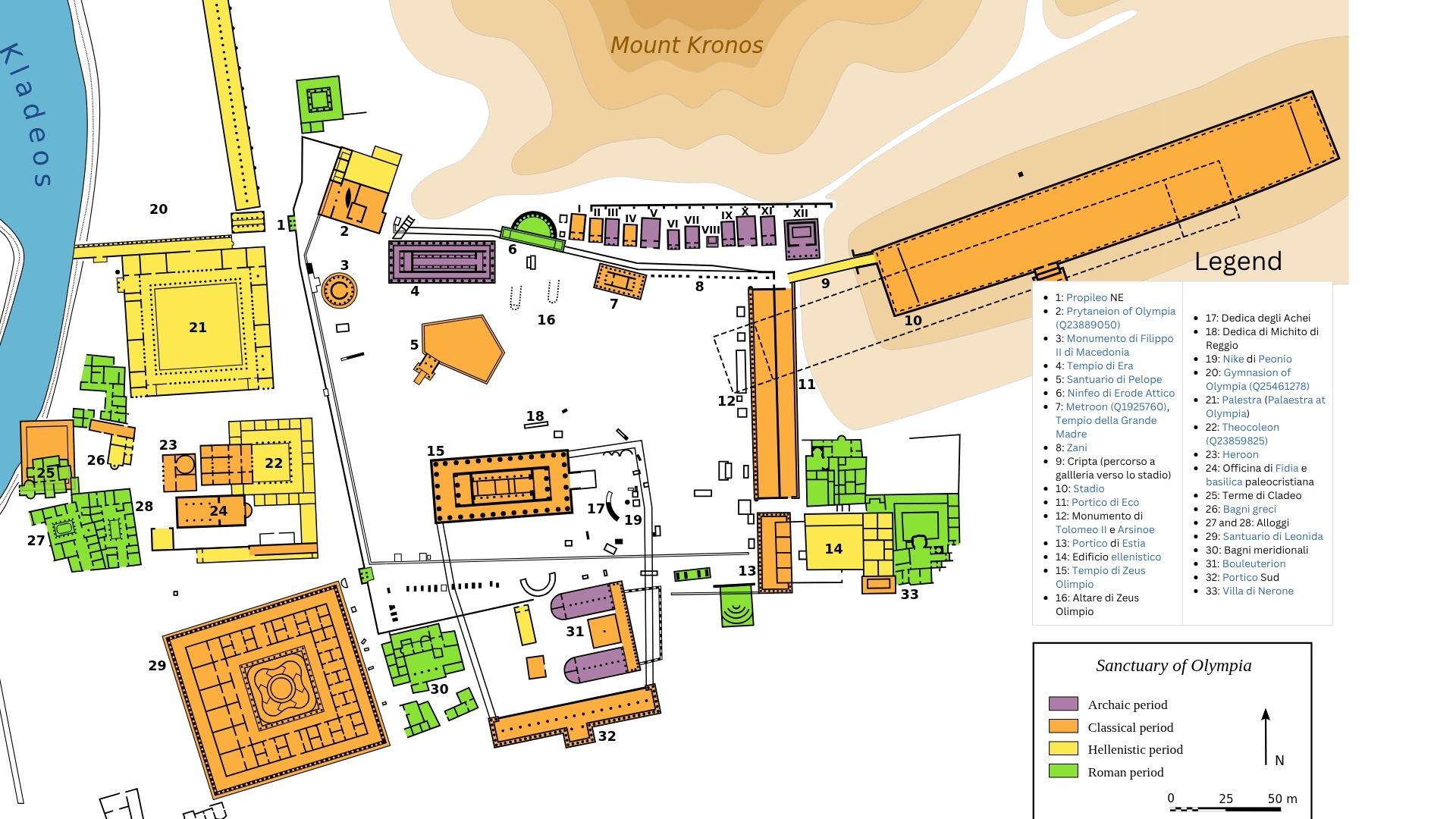
At its height, the sanctuary was a substantial complex of around 70 buildings and monuments, including temples, treasuries, stoas, baths and athletic facilities. What survives today is mostly foundations, toppled column drums and the outlines of walls — which is precisely why Olympia divides visitors.
You will not find the sculptor Phidias at work in his studio or athletes in the baths. What you get instead is the actual ground: the same track, the same starting line, the same sacred grove.
Ancient Olympia and Mount Olympus are two entirely different places, and the two are constantly confused. Mount Olympus, the mythological home of the gods, is the highest mountain in Greece and lies in the north of the country.
The Archaeological Site of Olympia is in the Peloponnese, in southern Greece — a different region entirely, in the ancient territory of Elis, today the regional unit of Ilia.
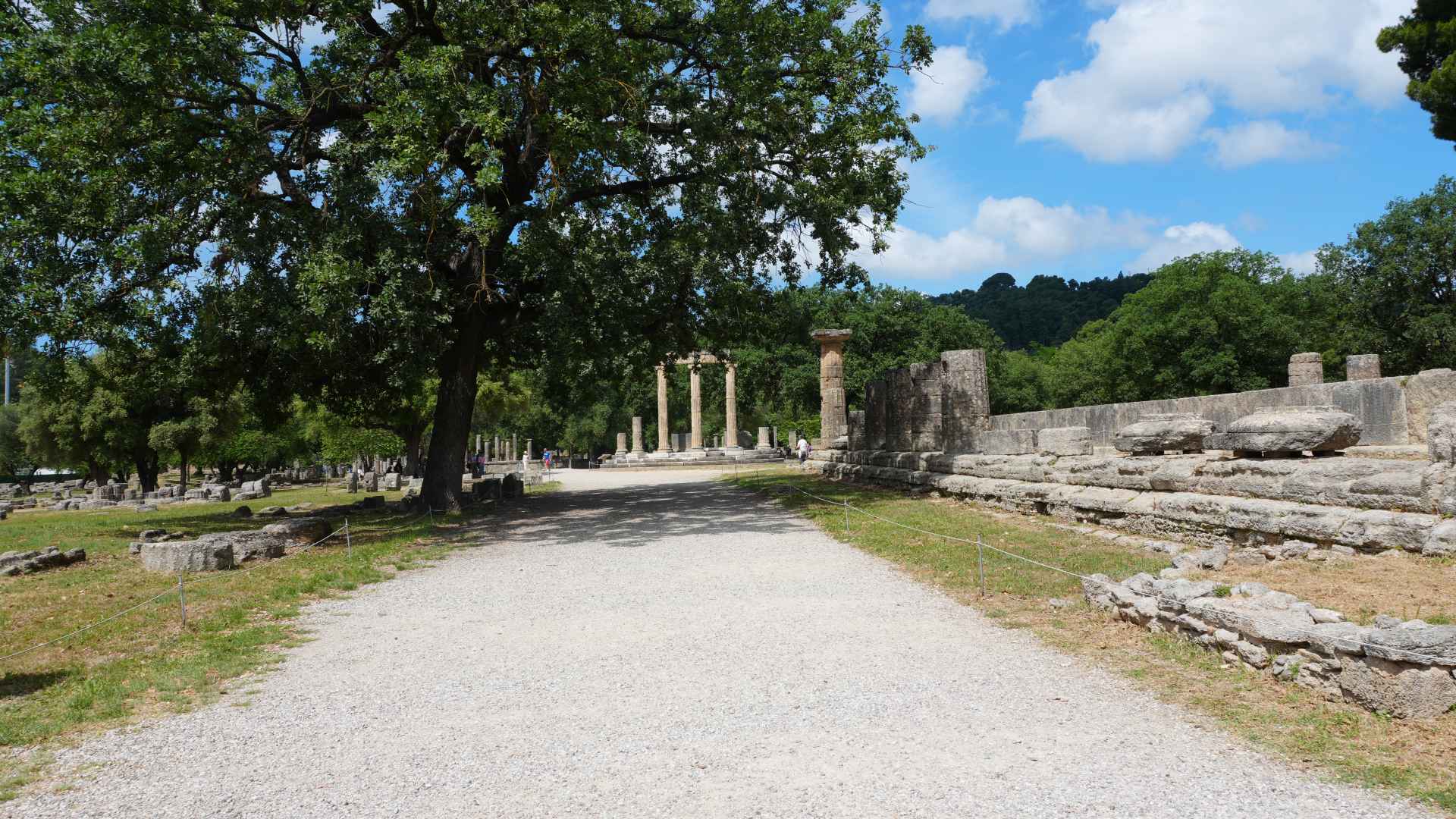
The Altis was the walled sacred precinct at the heart of Olympia, an enclosed religious area containing its own sacred grove of trees. It was established centuries before the monumental Temple of Zeus was built between 470 and 457 BC (UNESCO).
Inside the Altis stood the Temple of Zeus, the Temple of Hera, the treasuries of various Greek city-states, the Bouleuterion where athletes swore their Olympic oath, and open-air altars for offerings to the gods.
The greatest of these was the Altar of Olympian Zeus, an extraordinary ash altar unlike the stone and marble altars familiar from other Greek sanctuaries. Pausanias, writing in the second century AD, places it approximately equidistant from the Pelopion and the Sanctuary of Hera and describes it as having been made from the ash of the thighs of animals sacrificed to Zeus.
He records a lower platform, or prothysis, with a circumference of about 125 feet (38 metres), a smaller upper stage with a circumference of about 32 feet (10 metres), and a total height of approximately 22 feet (6.7 metres). Sacrificial animals were killed on the lower platform, but their thighs were carried to the highest part of the altar and burned there.
The upper steps were also made of ash, while the steps leading to the lower platform were of stone. Pausanias notes that sacrifices to Zeus continued even when the Olympic festival was not being held, and that the Eleans replenished the altar annually by mixing ash from the town hall with water from the Alpheius River and applying the mixture to it (Pausanias, 5.13.8–10).
The altar’s exact archaeological location has not been securely identified, although Pausanias’s description establishes its position within the sanctuary and archaeological evidence has helped scholars reconstruct its likely form.
It was therefore not simply a pile of accumulated sacrificial ash, but a deliberately constructed and continually renewed ritual monument, built up over generations through the repeated sacrifice of animals to Zeus.
What made Olympia distinctive wasn’t the mix of religion and sport — several Greek sanctuaries had both. It was Panhellenic status: recognition from rival city-states that agreed on almost nothing else. Delphi held the same status through its oracle; Olympia earned it through Zeus and the Games.
“It was some sort of a mecca for the ancient Greeks, because this was where Zeus was born, this was where the gods were born.” — Niki Vlachou, Niki Olympic Tours, resident guide in Olympia.
People traveled from across the Greek world and its colonies hoping to visit once in their lifetime, either as athletes competing for glory, or as pilgrims seeking favour from the gods simply by making the journey.
Niki Vlachou, who grew up in Olympia, is named after Nike, the goddess of victory, and was raised on her grandmother’s bedtime stories of the Greek gods. She describes still feeling “an energy coming in from the soil of this sacred place” as she walks the ruins.
The traditional founding of the ancient Olympic Games is dated to 776 BCE. The Games were known as the Olympiad because they were held every four years, and Greek city-states sent athletes to Olympia under the Olympic Truce, or ekecheiria.
The mythology of Zeus gave Olympia its religious pull, but the practical reason the Games were established here was strategic.
Greece was divided into competing city-states that frequently went to war — Sparta and Athens being the best-known rivalry — so the festival needed somewhere neutral, reachable and far from any single dominant power.
“They needed to find a place that would be the less difficult and the less dangerous to access and the less close to other important city-states.” — Niki Vlachou
Olympia met every condition. It sat in a valley between two rivers, close enough to the sea that travellers could arrive by ship from the islands and colonies.
The surrounding land was fertile enough to feed and water the enormous crowds. It was accessible overland on foot or horseback, and it had a natural landmark to navigate by. No other site in Greece combined all of these advantages.
Olympia occupies flat ground at the foot of a single significant hill: the Hill of Kronos, also called Mount Kronios. In Greek mythology, Kronos was the father of the gods, who swallowed his own children to stop them from overthrowing him, as he had overthrown his father, Uranus.
Zeus, his youngest son, was smuggled away and raised in secret, later returning to overthrow Kronos and free his siblings. For the ancient Greeks, this hill carried enormous sacred weight as the place where, in myth, the gods themselves were saved.
Most ancient Greek sanctuaries were built on defensible hilltops. Olympia is unusually flat and green, which gives it a much calmer atmosphere than Greece’s mountain sanctuaries.
Under the Olympic Truce, city-states agreed to suspend hostilities so athletes and spectators could travel safely to and from Olympia. The festival drew far more than sport.
Poetry, sculpture, painting, and song were performed here, religious sacrifices were made, and economic deals, political negotiations, and military alliances were all conducted alongside the competitions.
The Games began as a single running race and grew to include up to twenty events at a single Olympiad. Running, wrestling, javelin, discus, and the pentathlon are recognisable to modern audiences and remain part of the Games today.
Others, chariot racing above all, have no modern equivalent. Only free men could compete, with one exception: female chariot owners could enter horses and teams, even though they could not compete in person.
The best-known example is Cynisca of Sparta, whose four-horse chariot team won at Olympia in 396 BC. She became the first woman known to win an Olympic victory, although she did not drive the chariot herself; as the owner and breeder of the horses, she was credited with the victory. She won the same event again in 392 BC.
Victors received the kotinos, a wreath cut from a wild olive tree growing beside the Temple of Zeus. There was no prize money at Olympia. The wreath, and the right to have a statue erected in the Altis, was the highest honour available in Greek public life.
According to Pausanias, married women were forbidden from attending the Olympic Games, with a punishment of death prescribed for any woman caught violating the rule.
There was, however, one notable exception: the priestess of Demeter Chamyne, who was permitted to watch the Games from a white-marble altar opposite the judges. Pausanias also makes clear that unmarried girls were allowed to attend.
The priestess was therefore not the only woman who could watch the Games, but she was the exceptional married woman granted this privilege (Pausanias, 5.6.7; 6.20.9).
Women were not entirely excluded from competition at Olympia. A separate festival, the Heraean Games, was held in honour of Hera and was open to young unmarried women and girls. According to Pausanias, the competitors were divided into three age groups and took part in a single running event.
The race was a shortened version of the men’s stadion. Pausanias says that the girls ran over a course about one-sixth shorter than the men’s, which would have been approximately 160 metres if the Olympic stadion is taken as about 192 metres. They did not therefore run the full length of the men’s course.
The winners received an olive crown, and each victor was entitled to dedicate a statue of herself in the Temple of Hera, with her name inscribed on it. Pausanias also describes sacrifices associated with the festival, including the sacrifice of cattle to Hera (Pausanias, 5.16.2–3).
I wasn’t expecting to feel anything much when I visited the Ancient Stadium at Olympia. But entering through the archway onto a track that you can still run on was a little spine-tingling. I think it’s because it’s not roped off like so many parts of UNESCO World Heritage sites. You can kneel down on the starting line, and it’s impossible not to be thrilled by the experience of being in the same spot as the ancient athletes competing in the first Olympic Games.
Many of the events of the ancient Olympiad were held in the Ancient Stadium of Olympia, east of the Altis. Athletes entered through the Krypte, the vaulted stone entrance built in the late third century BC, and took position at the balbis — the two stone markers cut into grooved white stone blocks that gave athletes leverage at the start.
[IMAGE: close crop of the balbis, the grooved stone starting line, with a visitor’s feet in position | ALT: The original stone starting line, or balbis, in the ancient stadium at Olympia]
The two starting markers sit 600 “Olympic feet” apart: 192.27 metres of packed clay. The stadium had no built seating. Spectators sat on mudbrick and earthen embankments shaped into a natural amphitheatre holding up to 45,000 people. Small wells dug into the embankments to supply drinking water later became votive pits for sacrificial offerings. The north bank was reserved for the priestess of Demeter.
You can walk through the Krypte, enter the stadium, and run a lap or a race across the original ground. Almost nobody tells visitors this in advance, and it is the single best reason to come.
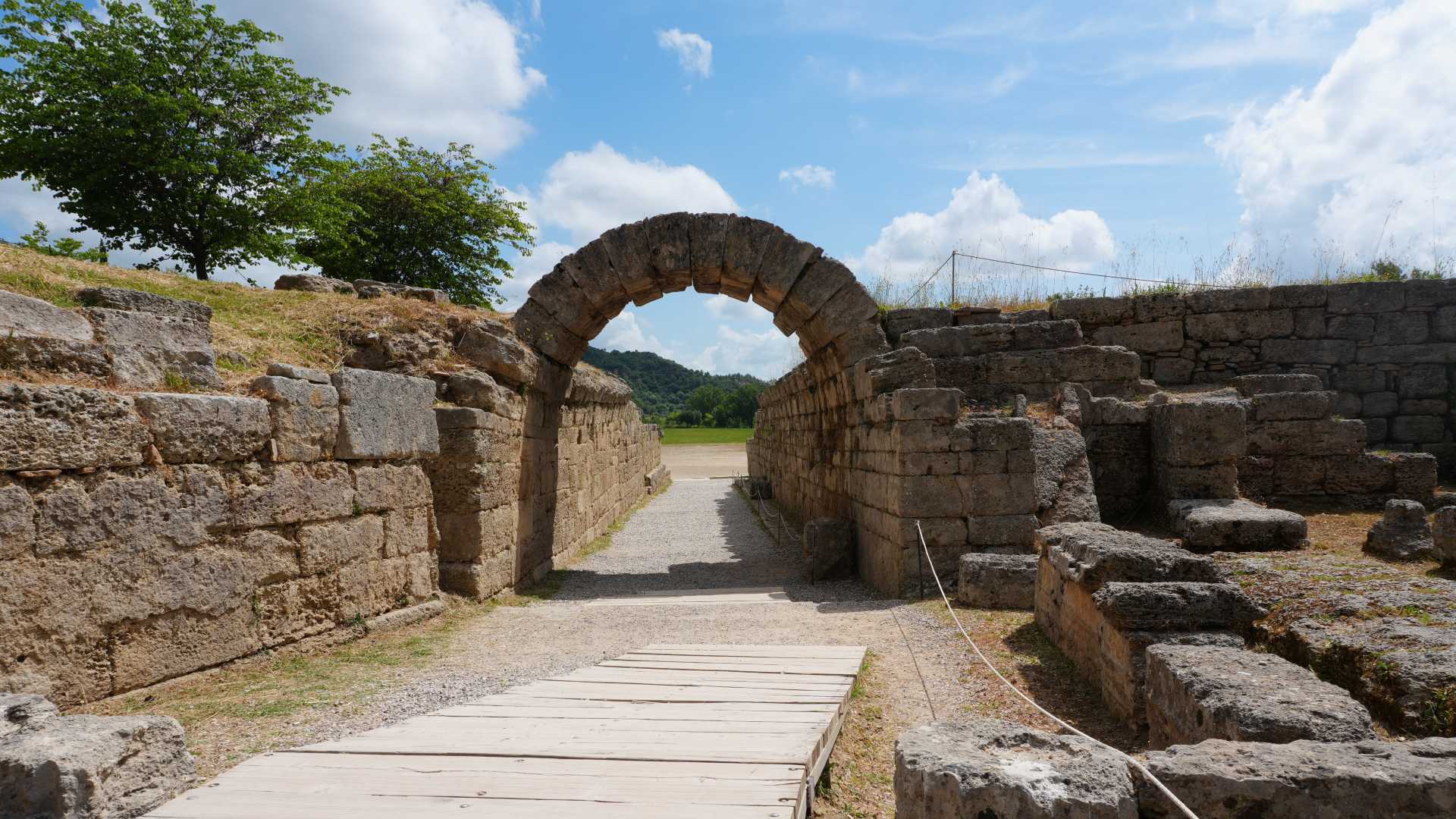
I wasn’t expecting to feel anything much when I visited the Ancient Stadium at Olympia. But entering through the archway onto a track that you can still run on was a little spine-tingling. I think it’s because it’s not roped off like so many parts of UNESCO World Heritage sites. You can kneel down on the starting line, and it’s impossible not to be thrilled by the experience of being in the same spot as the ancient athletes competing in the first Olympic Games.
Many of the events of the ancient Olympiad were held in the Ancient Stadium of Olympia, east of the Altis. Athletes entered through the Krypte, the vaulted stone entrance built in the late third century BC, and took position at the balbis — the two stone markers cut into grooved white stone blocks that gave athletes leverage at the start.
The two starting markers sit 600 “Olympic feet” apart: 192.27 metres of packed clay. The stadium had no built seating. Spectators sat on mudbrick and earthen embankments shaped into a natural amphitheatre holding up to 45,000 people. Small wells dug into the embankments to supply drinking water later became votive pits for sacrificial offerings. The north bank was reserved for the priestess of Demeter.
You can walk through the Krypte, enter the stadium, and run a lap or a race across the original ground. Almost nobody tells visitors this in advance, and it is the single best reason to come.
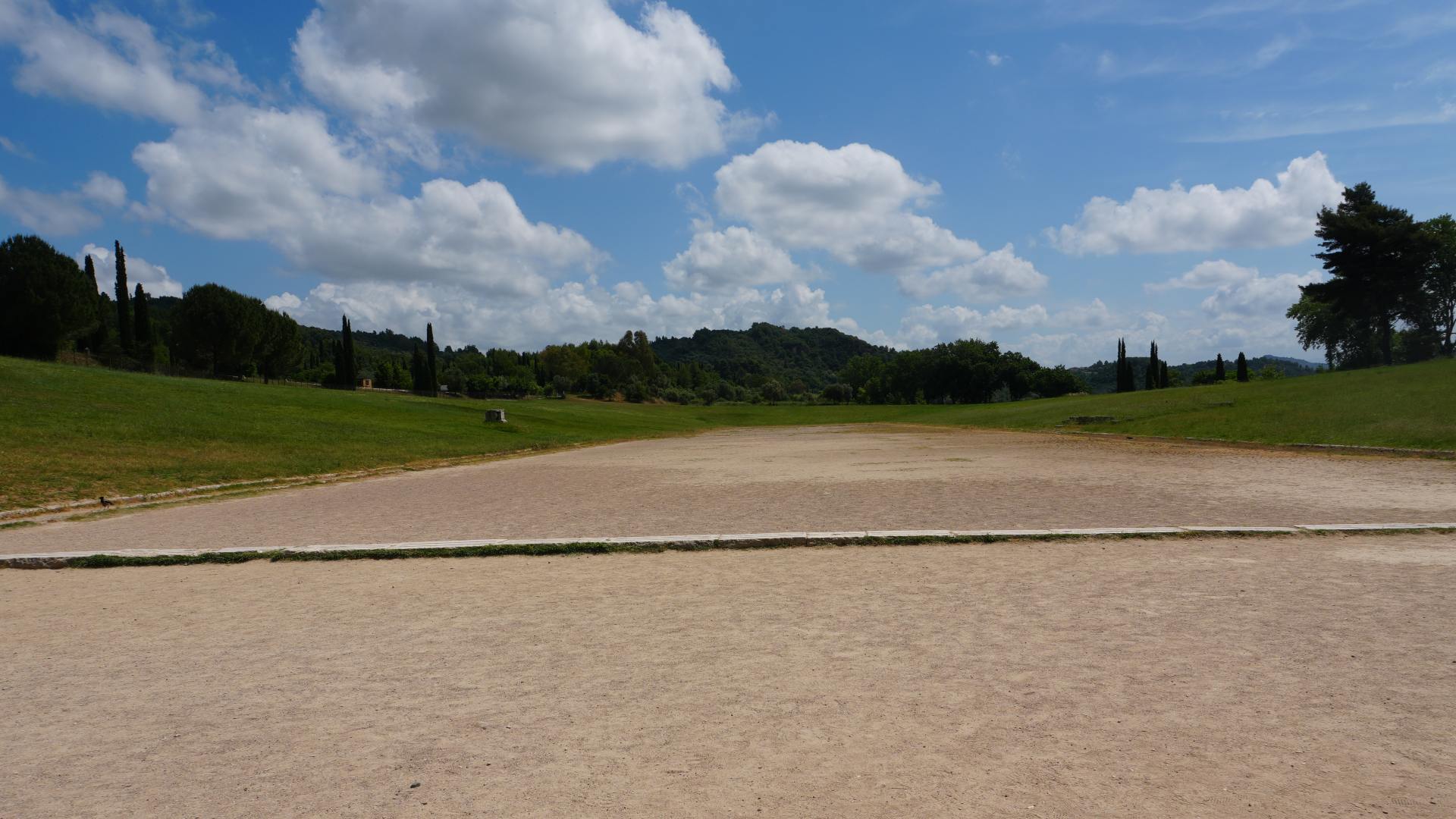
Yes. There is no rope, no barrier, and no separate ticket — the track is open ground, and visitors run it every day.
You can start at the balbis, the original stone starting line, and run the full 192.27 metres to the finish, which is the same distance the stadion sprinters covered in 776 BCE.
Nothing marks the lanes, so you set your own. Morning is best: the clay is cooler, and the stadium is emptier.
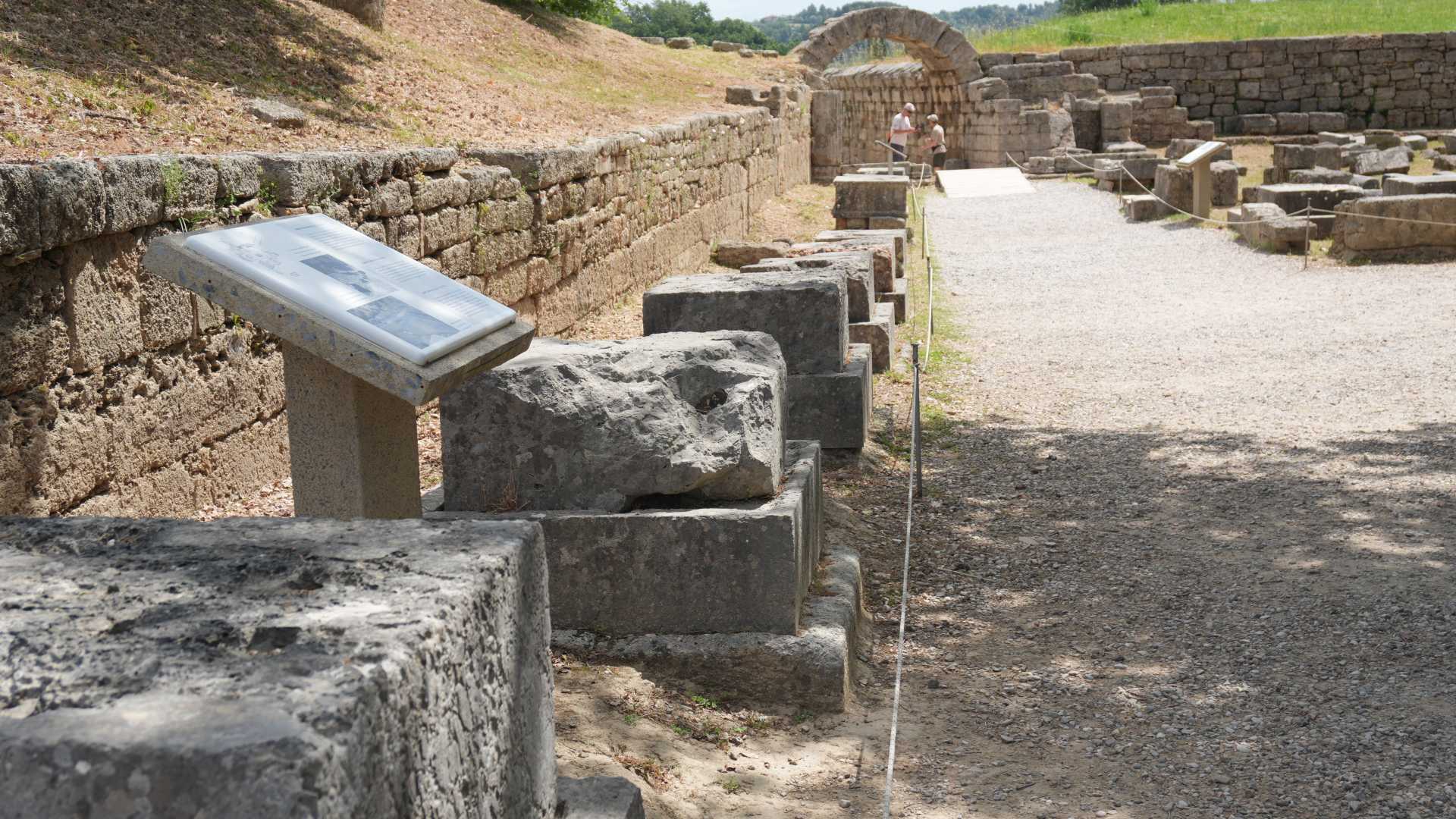
Cheating was a persistent problem at the ancient Olympics. By the fourth century BC, a row of bronze statues of Zeus — the Zanes — lined the entrance to the Krypte, funded entirely by fines levied against athletes caught cheating and positioned so that every competitor had to walk past them on the way into the stadium. You can still see the row of stone blocks that supported them.
Nearby stand hundreds of surviving statue bases with their original inscriptions, which once held statues of Olympic victors. Directly opposite are the bases of a very different set of statues: memorials naming the athletes caught cheating.
“What you get if you win, what you get if you cheat — fame and shame.” — Niki Vlachou
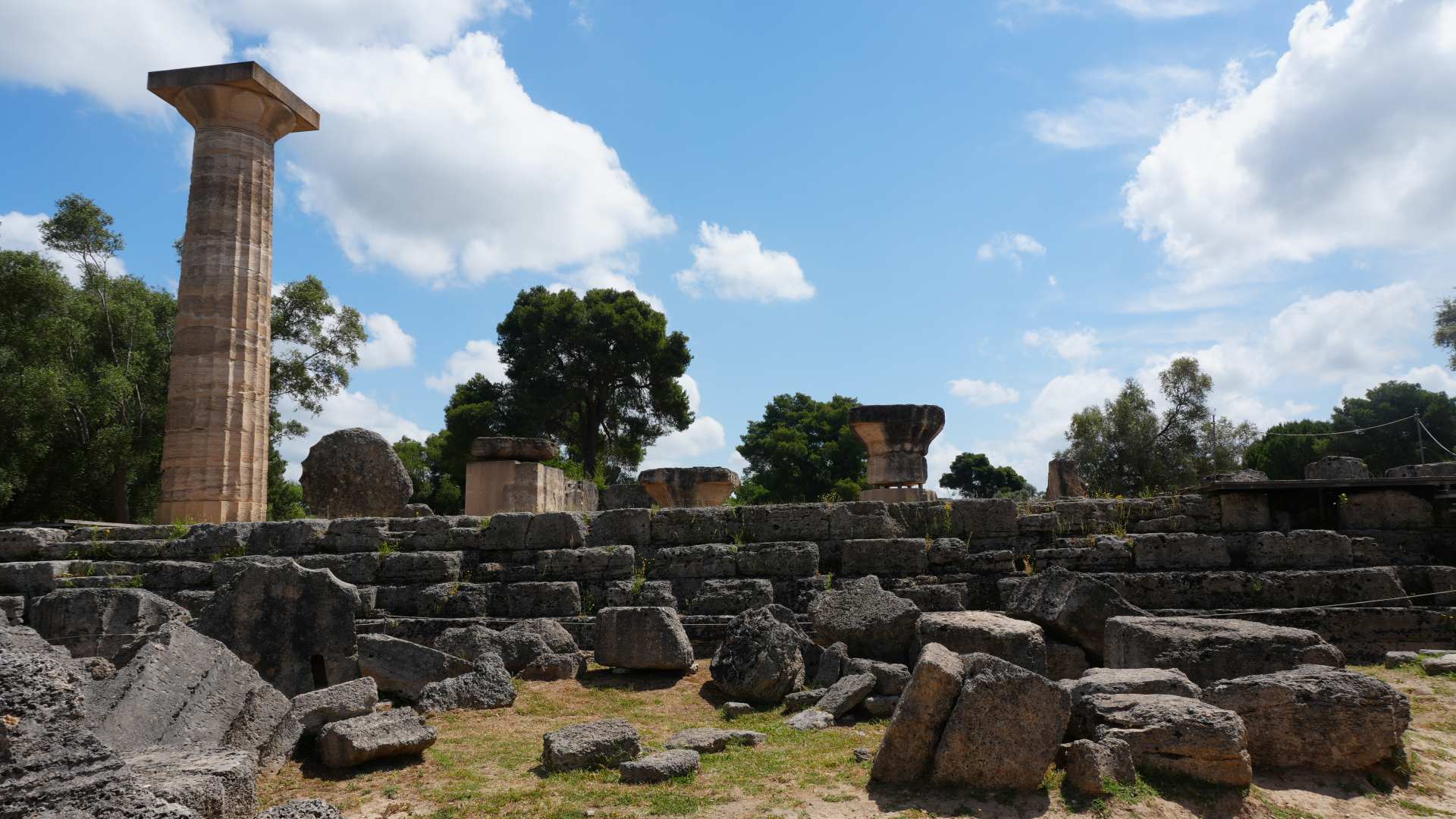
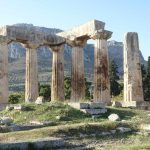
I was keen to see the Temple of Zeus. I knew there wouldn’t be much left of it, but I was surprised by the sheer size and scale of the fallen column drums. It must have been a truly mighty sanctuary to have housed the Statue of Zeus that was one of the Ancient Wonders of the World.
Only the foundations and toppled column drums of the Temple of Zeus remain. Built between 470 and 457 BC, it was a Doric temple of local limestone, covered in stucco to simulate marble, and remodelled repeatedly across its history.
The fallen drums lie roughly where they came to rest, which gives a better sense of the building’s mass than a reconstructed colonnade would.
Inside the temple stood the Statue of Zeus, one of the Seven Wonders of the Ancient World — and one of the few whose actual site you can still stand in. The statue was chryselephantine, a technique combining gold and ivory plates fitted over a wooden frame, and depicted Zeus seated on a jewel-encrusted cedarwood throne.
Ancient descriptions have it filling almost the full interior height of the temple; figures of around 12 metres are commonly cited. It no longer survives, and ancient and later accounts of how and when it was lost do not agree.
The Statue of Zeus was created by the sculptor Phidias, who had earlier made a comparable statue of Athena for the Parthenon in Athens.
His workshop sits just outside the Altis, and excavators found one of the artist’s own drinking cups there, inscribed with his name — one of the most direct personal traces of a named ancient artist anywhere in Greece.
It has just reopened after an extensive period where it was closed for a significant renovation.
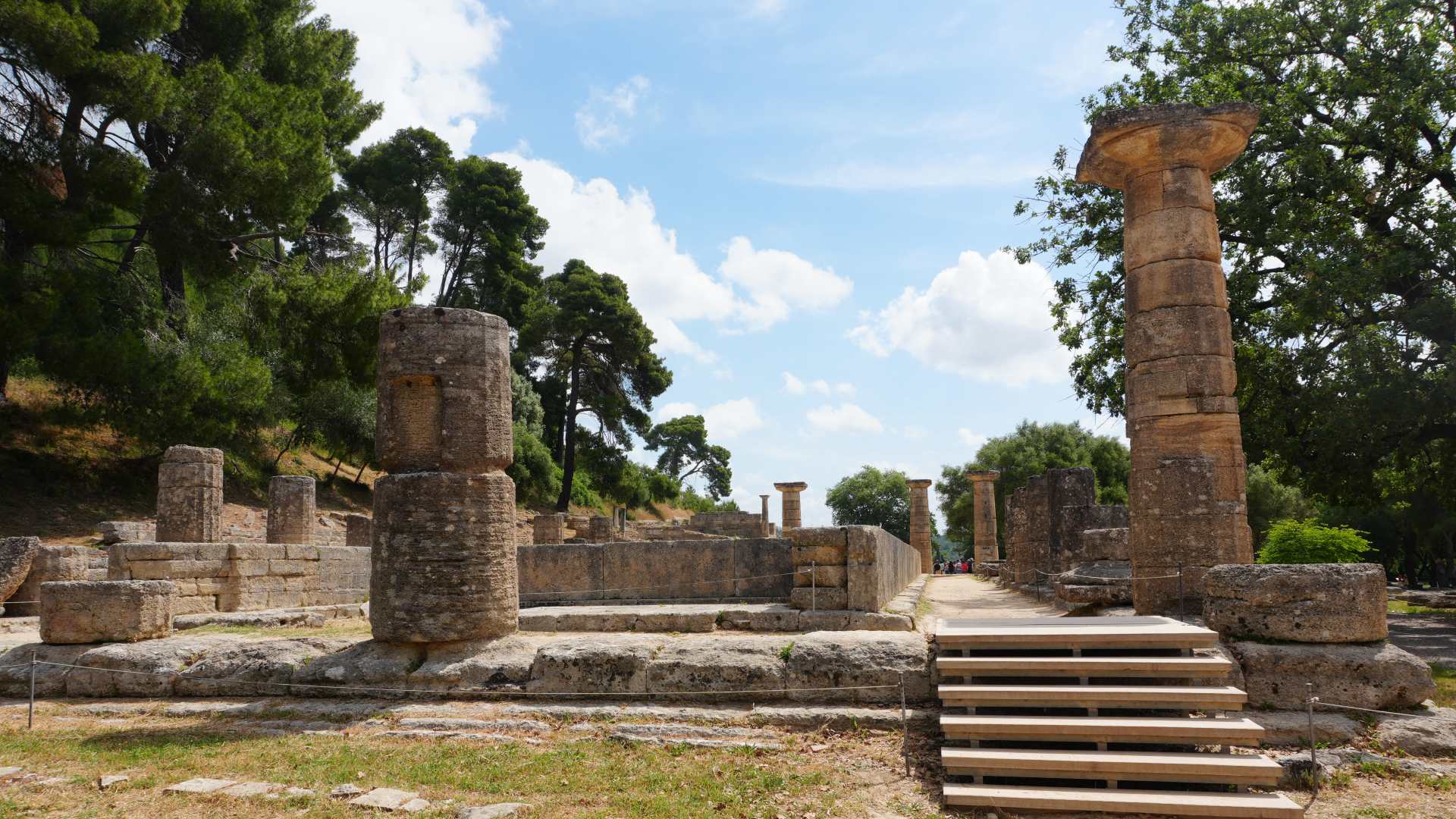
The Temple of Hera, also called the Heraion, is considerably older than the Temple of Zeus and is generally regarded as the oldest surviving temple in the Altis. Building activity here dates from around 600 BC.
It is ringed by a single row of Doric columns, originally made of oak and gradually replaced in stone as the wood decayed over the centuries.
The entrance to the Temple of Hera matters for the modern Games: this is where the Olympic flame is lit today, using sunlight alone, before beginning its journey to each host city.
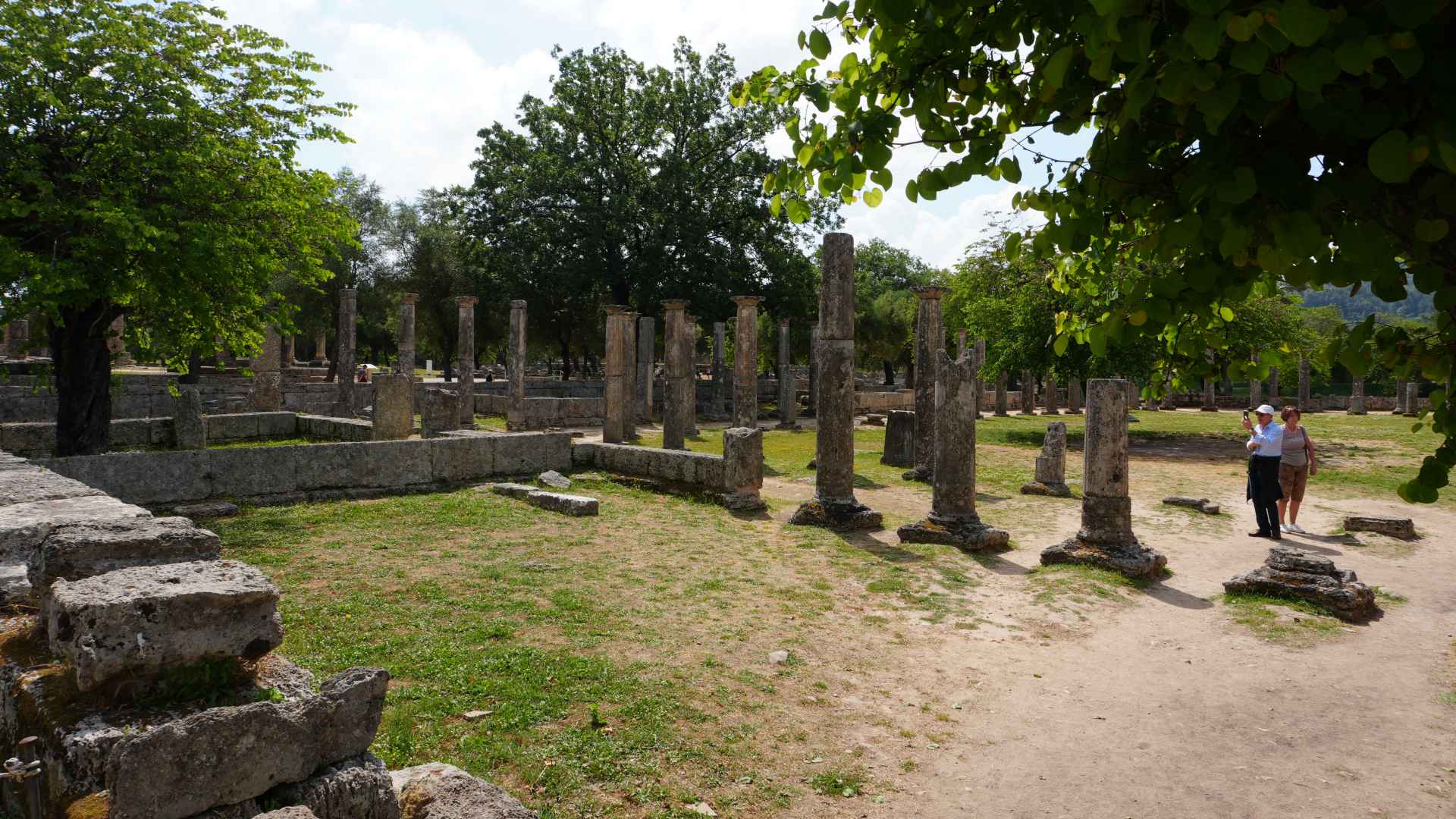
When athletes arrived at Olympia, they trained in its two gymnasiums, the schools for body and mind, whose foundations and some restored columns still stand. In their open courtyards, athletes trained naked for their specialist events — the Greek word for nude, gymnos, is the origin of the word gymnasium.
Niki Vlachou uses these courtyards to get visitors to picture the young athletes “sweating and running and wrestling” through the months of training that preceded the festival.
The Palaestra was a dedicated wrestling school, built around a large square sand floor and surrounded by rooms opening onto covered porticoes.
Boxing and wrestling were taught here, alongside pankration, a close-to-rule-free combat sport in which serious injury and occasional death occurred. You can walk the full extent of the Palaestra among its surviving columns.
Close to the stadium stands the Prytaneion, where Olympia’s priests lived and where an eternally burning ceremonial flame was kept — unrelated to the modern Olympic torch, but a continuous fire nonetheless.
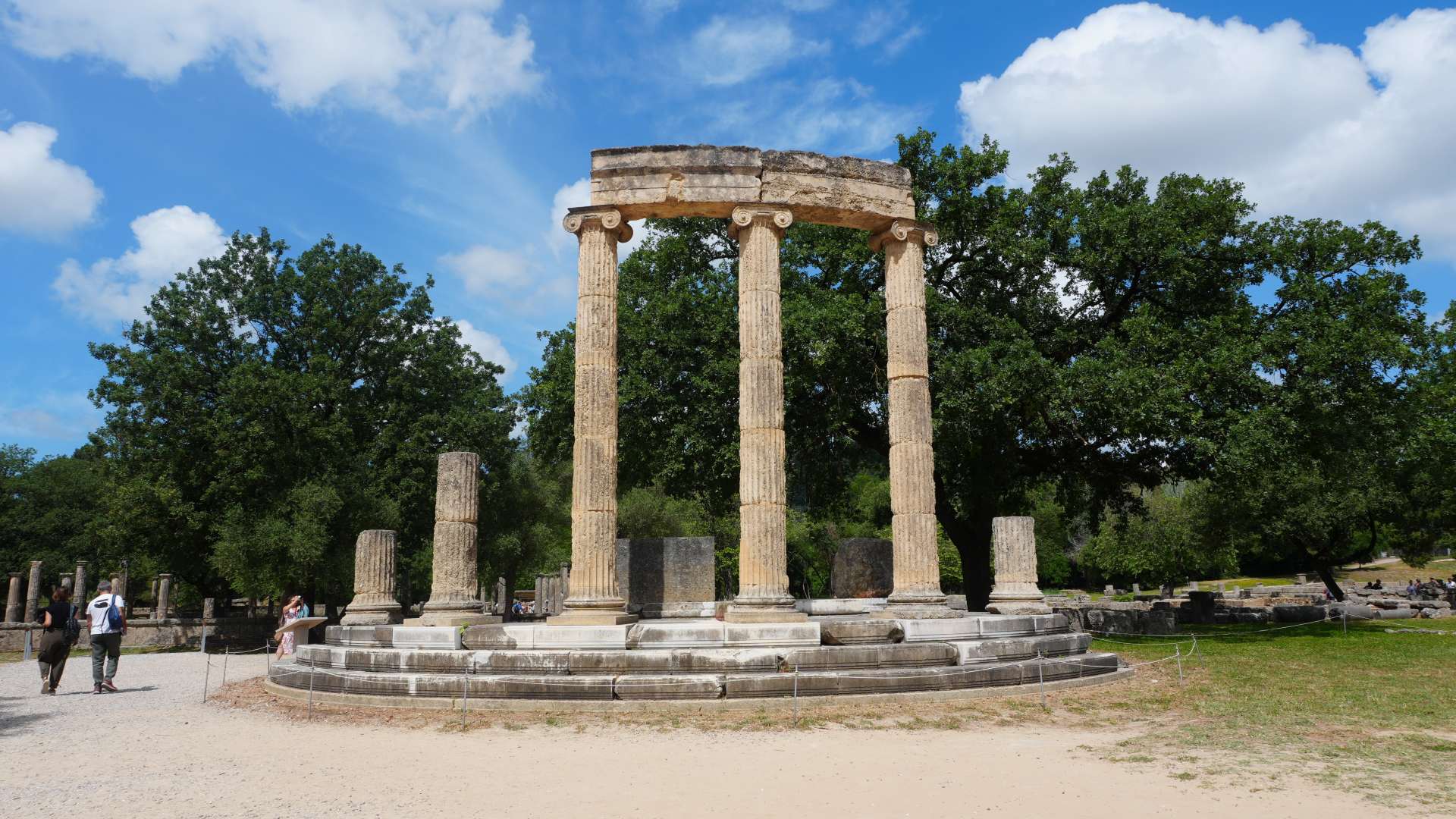
Beside it stands the Philippeion, a round building also called the Tholos, commissioned by Philip II of Macedon, father of Alexander the Great, after he brought Greece under Macedonian control.
It is the most architecturally distinctive structure on the site and a marker of the moment Olympia’s Panhellenic sanctuary acquired a Macedonian dynastic monument at its heart.
Olympia kept being rebuilt long after the Classical period. Hellenistic and Roman additions include the Leonidaion guest house for official visitors, the Nymphaeum that supplied the sanctuary with water, and Roman thermal baths — a reminder that this was a working institution for over a thousand years, not a single-period ruin.
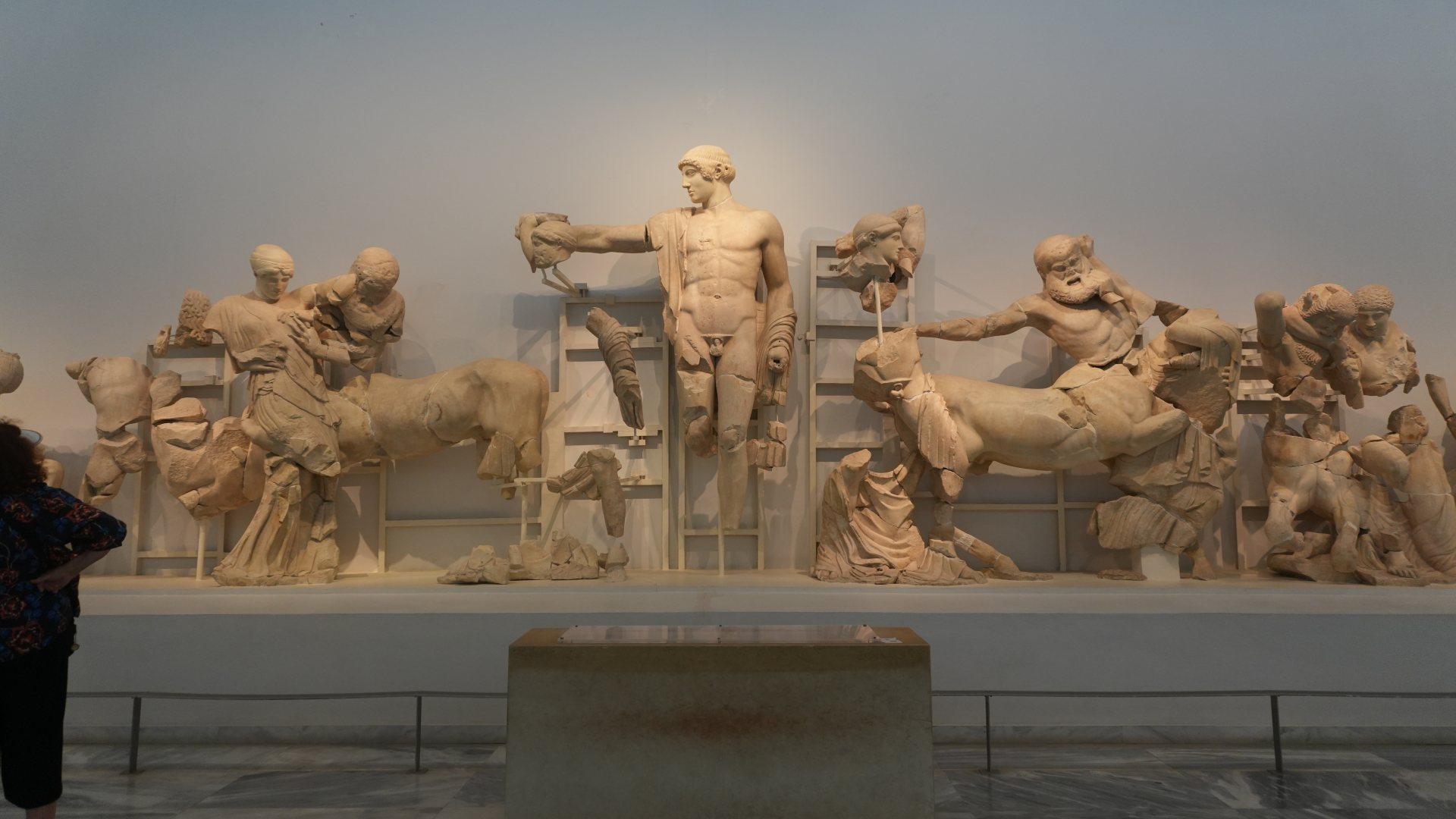
This is one of my favorite museums in Greece. It is as spectacular as the nearby museum of Ancient Delphi – don’t miss it.
The Archaeological Museum of Olympia holds what was recovered from the Temple of Zeus and the wider sanctuary, including the temple’s surviving pediment sculptures and decorative acroteria.
Its relationship to the site is like the Acropolis Museum’s relationship to the Acropolis: the sculpture that gave the buildings their meaning is in here, not out there. Visiting the site without it means seeing only the skeleton.
The integrated ticket also covers the Museum of the History of the Olympic Games of Antiquity and the Museum of the History of the Excavations in Olympia. Both are small.
The Games museum is the more rewarding of the two if you have an extra half hour and any interest in how the events were actually run.
The Olympic Games were celebrated at Olympia from 776 BC to 393 AD (UNESCO) — a span of nearly 1,170 years. Very few human institutions have held the same purpose for that long.
Olympia’s decline began before its destruction. Greece became a Roman province, the Games came to be administered by Roman authorities, and Roman athletes competed alongside Greeks.
After the empire adopted Christianity, the festival continued until the last Olympiad in 393 AD. In the 390s, Theodosius I introduced legislation against pagan sacrifice and religious festivals, effectively undermining the religious framework on which the Olympic Games depended.
Although 393 is conventionally given as the date of the last ancient Olympics, there was no surviving edict specifically banning the Games, and their final cessation appears to have been more gradual.
The physical destruction came a generation later and under a different emperor. The Temple of Zeus was apparently destroyed around 426 AD during the persecution of pagans in the late Roman Empire, following an edict of Theodosius II enforcing the ban on pagan festivals.
These two events are frequently merged into one in popular accounts. They were roughly thirty years apart: Theodosius I ended the Games; Theodosius II’s edict preceded the destruction of the temples.
Then Olympia disappeared. Earthquakes, floods, and river silt buried the sanctuary, and human settlement in the area was interrupted in the 7th century AD as a result of natural disasters.
Olympia’s rediscovery in the 19th century fed directly into the Games’ modern revival. Inspired partly by the ongoing German excavations, Pierre de Coubertin founded the International Olympic Committee in Paris in 1894 and revived the Games in Athens in 1896 — not at Olympia itself, and nearly 1,500 years after the last ancient Olympiad.
Olympia has never hosted a modern opening ceremony, but it kept one formal role: the Olympic flame for every Games since 1936 is still lit here, at the Temple of Hera, using sunlight and a parabolic mirror, before travelling to that year’s host city.
The burial preserved it. Excavation and preservation of Ancient Olympia has been the responsibility of the German Archaeological Institute at Athens since the 1870s, and a new systematic excavation began in 1936, timed to the Berlin Olympics, under Emil Kunze and Hans Schleif.
The stadium’s working life did not end in antiquity either. It was partially restored and used again for the 2004 Athens Olympics, when the shot-put events were held on the same ground as the ancient Games — the first time in Olympia’s history that women competed there.
The men’s event, held on 18 August 2004, produced one of the strangest results in Olympic history: Ukraine’s Yuriy Bilonoh took gold ahead of the American Adam Nelson, then was stripped of the title in December 2012 after his stored sample was retested, and Nelson was formally awarded the gold in 2013 — nine years after competing.
An athlete cheated at Olympia and was publicly named for it, roughly 2,400 years after the Zanes were erected to shame exactly that.
Although the Games have not been held at Olympia for around 1,600 years, the site retains enormous meaning for modern Greeks.
“We are very, very proud of the fact that the Olympic Games started in our country. Almost every Greek visits Olympia as often as he can… I think it’s a must-visit place, and after you leave it, you’re going to change the way you think about certain things.” — Niki Vlachou
For the full conversation about how the Games worked and what Olympia meant to the Greeks who travelled here, listen to Take Me To Europe Podcast Episode 7: The Olympic Games at Ancient Olympia.
The integrated ticket costs €20 full price and €10 reduced, is valid for one day, and covers the Archaeological Site of Olympia, the Archaeological Museum of Olympia, the Museum of the History of the Olympic Games of Antiquity, and the Museum of the History of the Excavations in Olympia.
Individual tickets for single areas are no longer issued.
Opening hours are 8 am to 8 pm from May to October and 8.30 am to 3.30 pm from November to April, with last admission fifteen minutes before closing.
The site is closed on 1 January, 25 March, 1 May, Easter Sunday, 25 December and 26 December, with shortened hours on Good Friday and Holy Saturday.
Buying an electronic ticket in advance is worth doing: it protects you from the queues that build up when cruise-ship day trips arrive.
Personal, non-commercial photography without flash is permitted at the archaeological site and museums. Tripods are generally not allowed without prior clearance, and photographing museum sculptures with people posed alongside them is restricted in some Greek museums.
Drone photography is not permitted without a permit from the relevant Ephorate of Antiquities and separate clearance from the Hellenic Civil Aviation Authority. This is a formal application process, not something arranged on the day, and commercial aerial filming carries a significant daily fee.
If you’re planning any commercial photography or filming for a tour, blog, or business, apply well in advance through Greece’s Ministry of Culture (it’s not cheap.
Two to three hours is enough for the site at a comfortable pace, plus around an hour for the main museum. A half day covers both.
Travelers with more time often stay overnight in the town of Ancient Olympia so they can be at the gate when it opens, before the day-trip coaches arrive.
Olympia pairs well with two other Peloponnese sites if you have a car and a full day.
🔸 Ancient Messene is about 90 km southeast of Olympia, roughly 1 hour 35 minutes by road. It is one of the best-preserved classical Greek cities anywhere, with a stadium, gymnasium, theatre, and Asklepieion complex on a scale that rivals Olympia itself, but the ruins here are a city rather than a sanctuary — a useful contrast after a morning at Olympia.
🔸 The Temple of Apollo Epicurius at Bassae, a UNESCO World Heritage Site designed by Iktinos, architect of the Parthenon, sits in remote mountains roughly 80–90 minutes from Olympia by road. It’s currently protected by a large tent while restoration continues, which some visitors find detracts from the experience, but the setting — a stone temple alone on a high, windswept plateau — is unlike anywhere else in Greece. There is no public transport to Bassae; a car or organised tour is required.worldheritagesites+2
Both make Olympia a two-stop rather than one-stop day if you’re driving the western Peloponnese, though visiting either properly alongside Olympia in a single day is very tight — allow, at most, a full day for Olympia plus one site, not both.
The best time of year to visit Ancient Olympia is spring — roughly April to early June. The valley is green, temperatures are manageable, and the site is quieter than in high summer.
September and October work almost as well. July and August mean heat, cruise-day crowds, and very little relief on an exposed site; if you must come then, be at the gate for the 8 am opening.
I love the May wildflowers, but early June is the sweet spot for warmth and flowers; the site looks gorgeous. The Fall foliage is also lovely.
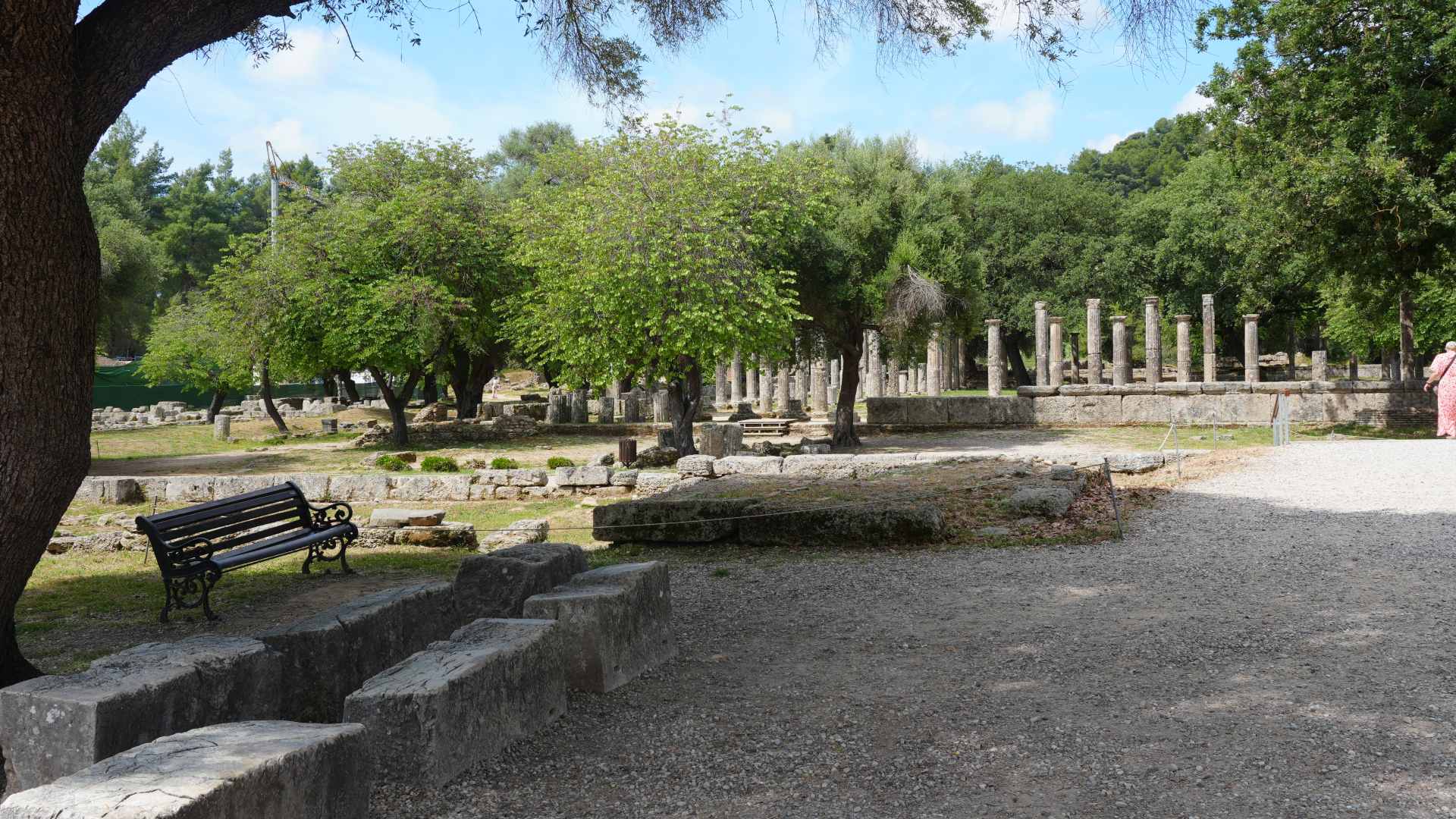
🔹 Shade is limited. Olympia is a flat, open archaeological zone. There are trees along some paths, but the Altis, the Temple of Zeus and the stadium are largely exposed. In summer, go first thing in the morning, bring water and a hat, and expect the walk to the stadium and back to be the hottest part of the visit.
🔹 The ground is uneven off the paved pathways. Paths are compacted earth and gravel with loose stone and low ruins underfoot. Wear proper shoes rather than sandals.
The site is broadly flat, which helps considerably with mobility, but the surfaces are not smooth, and there are few handrails.
That said, this is an easy site to get around, and it is not a large site. It is not situated on a hillside (Delphi) or at the top of an Acropolis.
It is also relatively compact compared to some of the large, sprawling archaeological sites in the Peloponnese, because it was a Sanctuary rather than a city.
🔹 Access and Mobility: Ancient Olympia is partly accessible for wheelchair users. Paved paths and ramps provide wheelchair access around parts of the archaeological site, although the extensive grounds include a variety of surfaces and some uneven areas. The Archaeological Museum of Olympia has ramp and lift access and accessible facilities.
🔹 Facilities are at the entrance, not inside. Plan for the café, toilets, and shop being clustered near the gate rather than distributed through the site, and note that the museum is a separate building requiring a short walk.
🔹 Signage is minimal. On-site interpretation is limited relative to the site’s importance. Bring a plan, a guidebook, or a guide.
Yes. The flat, open layout and the stadium’s original running track make Olympia one of the more child-friendly archaeological sites in Greece — kids can run the same 192-metre course as ancient athletes, which tends to hold their attention better than temple ruins alone.
The uneven ground means close supervision is still needed, and pushchairs may struggle on some unpaved stretches.
The Museum of the History of the Olympic Games of Antiquity, with its more object-based, story-driven displays, is generally more engaging for children than the main Archaeological Museum.
Ancient Olympia is about 290 km from Athens and takes approximately 3½ hours to reach by car.
The route follows the major highways across the Peloponnese before continuing west towards Olympia, and driving gives you the greatest flexibility if you want to visit other archaeological sites along the way.
If you are traveling without a car, KTEL Ilia operates bus services from Athens’ Kifissos bus station towards the Olympia area. Services can involve a change at Pyrgos or nearby Krestena, so check the current timetable when planning your journey; there is no regular direct Athens–Olympia coach. The complete journey generally takes four hours or longer, depending on the connection.
There is also a small regional railway linking Katakolo, Pyrgos and Olympia. This is particularly useful for visitors arriving at the port of Katakolo, rather than as a way of traveling from Athens: there is no regular passenger train connecting Athens with Pyrgos.
Hellenic Train continues to operate the Katakolo–Pyrgos–Olympia service, with timetable changes introduced in July 2026.
For most visitors coming from Athens, driving or joining an organised tour is therefore the most convenient way to reach Ancient Olympia, particularly if you want to combine Olympia with other sites in the western Peloponnese.
For travelers who would rather not manage trains, buses, and taxis, guided day trips run from Athens with hotel pick-up and return, and walking tours of the site itself are led by licensed local guides once you arrive.
This is a fantastic guided day trip from Athens that is highly reviewed and sells out quickly.
Katakolo Cruise Port is approximately 35 km from Ancient Olympia, a drive of around 35–45 minutes each way. Private taxis and transfers are available at the port, and pre-booked private excursions can allow you to spend two to three hours exploring the archaeological site and museum before returning to the ship.
If you’re coming from the cruise port, there’s an excellent and inexpensive return private transfer to Olympia that includes 3 hours of free time before the return to the port: Katakolo Cruise Port: Roundtrip transfer to Ancient Olympia.
A round trip, including the time at Olympia, generally takes around four to five hours, making it feasible for most cruise calls with sufficient time in port. Always check your ship’s all-aboard time and allow a generous margin for the return journey.
The site can be visited in half a day, but staying overnight buys you an early-morning visit before the crowds and unhurried time in the museum.
This is where we stay in Olympia. It is a quality four-star hotel but close enough to the main restaurant area and the archaeological park. As a small-group tour company, we love that we can book a year in advance and get great rates.
The Amalia Hotel Olympia sits close to the entrance to the archaeological site, surrounded by Mediterranean gardens, with an outdoor pool, restaurant, lounges, and a bar with a fireplace.
It is around 500 metres from the archaeological zone, which makes an early-morning walk to the gate very easy.
Perched on the edge of the mountain with wide views from its terraces, dining areas, bar and pool, Bacchus is a family-run hotel with comfortable rooms and modern bathrooms.
A good-value guesthouse with free Wi-Fi, air-conditioning, free parking and modern rooms with terraces, roughly a twelve-minute walk from the Temple of Zeus.
Olympia is a site where interpretation does most of the work, because so little of it is standing. A field of foundations only becomes a sanctuary if someone can rebuild it for you as you walk through it.
Olympia features on our small-group Ages of the Peloponnese Tour, a journey from the Bronze Age citadels to the classical sanctuaries of the Peloponnese, led by Dr Elena Soulioti, an Aegean Bronze Age archaeologist with a PhD from Durham University and nearly three decades’ experience as a licensed Greek guide.
Olympia is a charming site, but my favorite part of our tour day here at Olympia is visiting the museum with an expert who makes it all come alive and shows us how important Olympia was for the ancient world.

Yes. Ancient Olympia is one of the most important archaeological sites in Greece, but it is a site you need to understand rather than simply look at.
That distinction matters practically for a visit: treat Olympia as a sanctuary you read, not a stadium you glance at. The reward is in the accumulation — temples, treasuries, training grounds, and the track together — not in any single standing monument.
The sanctuary eventually contained temples, treasuries, altars, monuments and buildings associated with the Games, turning this small valley in the western Peloponnese into one of the most important sacred places in the ancient Greek world.
The most famous monument was the Temple of Zeus, one of the largest temples in the Peloponnese. Inside stood the colossal chryselephantine statue of Zeus by the sculptor Phidias, regarded by the ancient Greeks as one of the Seven Wonders of the Ancient World.
The statue itself has disappeared, but the remains of the temple and the archaeological evidence at Olympia help you understand the sanctuary’s scale and importance.
Then there is the stadium. Entering through the ancient athletes’ tunnel and standing on the roughly 192-metre track makes the history of the Games unusually tangible.
The stadium is remarkably simple compared with the monumental architecture of the sanctuary, but that simplicity is part of its appeal: you can stand where ancient athletes competed before crowds of thousands and see the physical space in which the Olympic competitions took place.
The Archaeological Museum of Olympia is an essential part of the visit, bringing together sculptures and objects recovered from the sanctuary that add context and meaning to the ruins.
Its highlights include the magnificent sculptures from the Temple of Zeus, the Nike of Paionios, and the famous Hermes carrying the infant Dionysos, traditionally attributed to the 4th-century BC sculptor Praxiteles, although its attribution remains the subject of scholarly debate.
The museum also contains finds that illuminate the religious, artistic, and athletic life of the sanctuary. In other words, the museum supplies much of the detail that the weathered ruins alone can no longer provide.
Olympia is therefore not a site I would judge simply by how many walls are still standing. Much of what you see today consists of foundations, columns and scattered architectural remains, and the site can be hot and exposed in summer.
Together, the ruins, stadium, and museum trace one specific arc: how a stretch of riverside land sacred to Zeus became the template for every international athletic festival that followed it, including the one lighting its flame here today.
If you are interested in ancient Greece, archaeology, mythology, the history of sport or the development of the Olympic tradition, Olympia is well worth the journey.
It is particularly rewarding when visited with enough time to see both the archaeological site and museum rather than treating Olympia as a quick stop to photograph the stadium.
Olympia also makes an interesting comparison with Delphi, another great Panhellenic sanctuary. Delphi was associated with Apollo and the oracle, while Olympia was the great sanctuary of Zeus and the home of the Olympic Games.
Visiting both gives you a much better sense of how the major Panhellenic sanctuaries functioned within the religious and cultural world of ancient Greece.
Pausanias. Description of Greece. Book 5, 16.2–3. Translated by W. H. S. Jones. Loeb Classical Library. Cambridge, MA: Harvard University Press, 1918.
UNESCO World Heritage Centre. “Archaeological Site of Olympia.” UNESCO World Heritage List, 1989. https://whc.unesco.org/en/list/517/
Professor Monique Skidmore is an award-winning anthropologist and travel expert who has spent more than 25 years exploring and documenting cultures around the world. As the founder of Take Me To Europe Tours, she combines academic expertise with a passion for cultural immersion and archaeology across Cyprus, Greece, Italy, Malta, and the wider Mediterranean. Olympia is a base town on her small-group Ages of the Peloponnese tour, and this guide draws on her repeated visits to the town itself, to the archaeological site, to the museum, and her many long conversations with local archaeologists who study the site. For more, visit her About Monique page.