
Quick answer: Salamis is the largest ancient city site in Cyprus, on the east coast, 10 kilometers north of Famagusta, in the part of the island administered as Northern Cyprus. Founded around 1100 BC and the island’s leading city for over a thousand years, it was where the apostles Paul and Barnabas first preached in Cyprus. Today it is an open archaeological park where you can walk through a Roman theatre that held 15,000 people, a gymnasium and bath complex, and Byzantine basilicas along the shore. Visiting means crossing the Green Line into the north, so allow at least two hours and plan the crossing in advance.
Salamis at a Glance
| Salamis at a glance | |
|---|---|
| Location | East coast of Cyprus, 10 kilometers north of Famagusta, in Northern Cyprus |
| Founded | Around 1100 BC (Late Bronze Age) |
| Best known for | Roman theatre, gymnasium and baths, Byzantine basilicas, Royal Tombs |
| Opening hours | Roughly 8:00 to 18:00 in summer, shorter in winter (confirm locally) |
| Entrance fee | Low, charged in Turkish lira, €3 or 50 to 150 Turkish Lira, recently around 50 TL, you can pay with a card. |
| Time needed | 2 hours minimum, 3 to 4 hours for the full site |
| Getting there | A 15 minute drive from Famagusta, requires crossing the Green Line into the north |
Salamis is the ruined ancient city on the east coast of Cyprus, 10 kilometers north of Famagusta, where you can walk through a Roman gymnasium, a 15,000-seat theatre, and marble bath houses spread along the Mediterranean shore. It was the leading city of ancient Cyprus for well over a thousand years, and it is the largest ancient city site on the island.
This guide covers what Salamis, Cyprus is, its history, exactly what to see, and how to visit, including the practical details that trip up first-time visitors to the north.
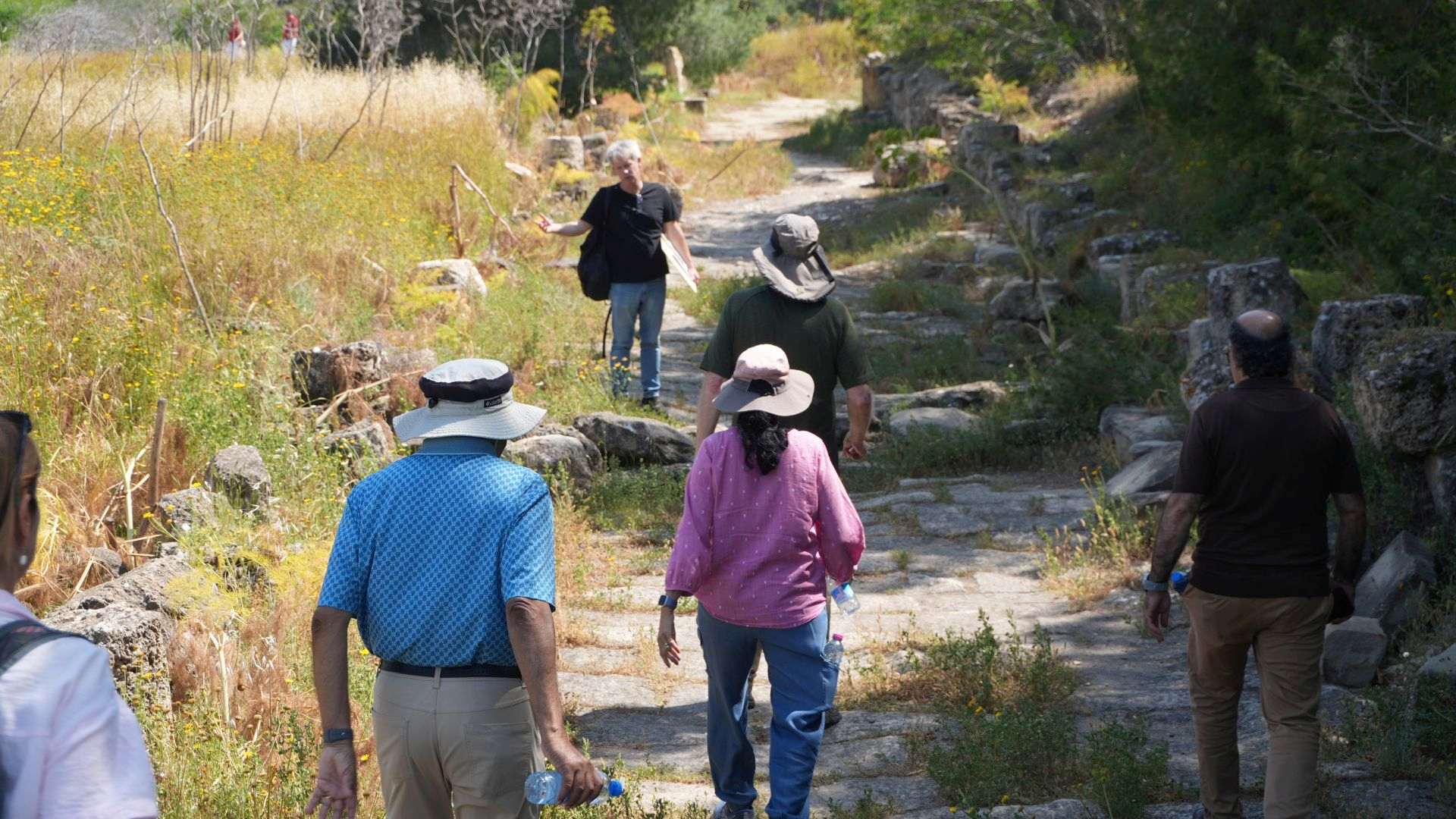
I have visited the ancient city of Salamis many times, in different seasons, often entirely alone, with just a pack of semi-domesticated puppies for company. I have examined all of it with an archaeologist as my guide and come along on our archaeologist-guided tours of Cyprus’ great archaeological treasures.
It is a large site, with little shade and no facilities. There is always something new to see and learn in this lovely wildflower-strewn ruined city by the sea.
Salamis was an ancient Greek city-state on the east coast of Cyprus, at the mouth of the River Pedieos, 10 km north of modern Famagusta. For most of antiquity it was the leading city of the island, a wealthy trading port that outlasted Assyrian, Egyptian, Persian, Ptolemaic, Roman and Byzantine rule before it was finally abandoned in the 7th century AD.
Today it is an open archaeological park. The ruins you walk through are mostly Roman and Byzantine, laid out along about 2 km of coastline and backed by pine and eucalyptus forest, with a great deal of the ancient city still unexcavated beneath the sand.
One point worth clearing up early. Salamis in Cyprus is not the same place as the Greek island of Salamis near Athens, site of the famous 480 BC naval battle against the Persians. They share a name because, according to legend, the Cypriot city was founded by a settler from that Greek island. If you are researching “Salamis ancient city” and getting mixed results, the Cyprus site is the one near Famagusta.
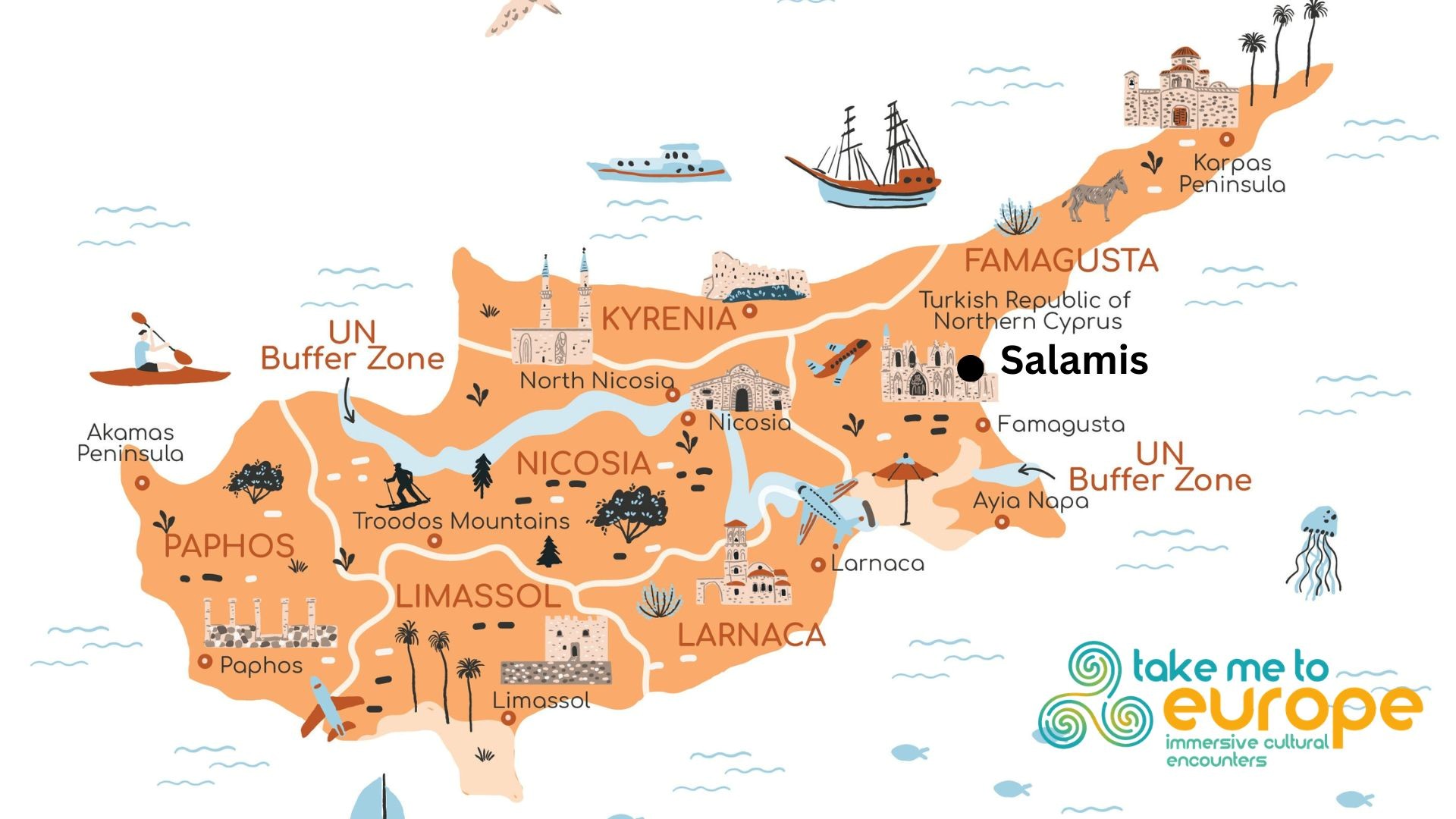
Salamis sits in the Famagusta District on the east coast, in the part of the island administered as Northern Cyprus. It is about 10 km north of modern Famagusta, a drive of roughly 15 minutes.
Because it is in the north, visiting means crossing the Green Line, the UN buffer zone that has divided the island since 1974. This is straightforward for most travelers, but there are real rules to follow, especially if you are driving. We cover the essentials below, and you can read the full details in our guide to crossing the Green Line in Cyprus.
According to Greek tradition, Salamis was founded by Teucer, son of Telamon, the archer hero of the Trojan War. Exiled by his father for failing to avenge his brother Ajax, Teucer sailed to Cyprus and named his new city after his home island of Salamis off the coast of Attica.
The archaeology tells a slightly different, and more grounded, story. The earliest finds at Salamis date to the 11th century BC, in the Late Bronze Age. The city appears to have grown as a successor to the nearby Bronze Age town of Enkomi, whose harbour was silting up, with people relocating to the new coastal site after an earthquake around 1075 BC.
So the founding myth and the physical evidence broadly agree on a starting point around 1100 BC, even if the Teucer legend itself has little direct archaeological support.
Cyprus was rich in copper, which made the island a vital node in early Mediterranean trade, and Salamis, with its natural harbour, became the main outlet for that trade with Phoenicia, Egypt and Cilicia.
Salamis packed an enormous amount of history into its long life. Here is the timeline that matters for understanding what you see on site.
🔸 11th to 8th century BC: The town develops around its harbour and grows into the leading city-kingdom of Cyprus. The Royal Tombs west of the city date from this early period (Britannica’s entry on ancient Salamis).
🔸 8th to 6th century BC: Salamis is named in Assyrian inscriptions as one of the kingdoms of Cyprus. It begins minting its own coins in the 6th century BC, following Persian models.
🔸 6th to 4th century BC: Under Persian control from about 525 BC, though with real autonomy. Greek culture flourishes under King Evagoras I (411 to 374 BC).
🔸 4th century BC: After Alexander the Great, Cyprus falls to the Ptolemies of Egypt. In 306 BC, Salamis is the site of a major naval battle where Demetrius I of Macedon defeats Ptolemy I.
🔸 58 BC onwards: Cyprus becomes Roman. Although Paphos serves as the provincial capital, Salamis remains the island’s most important commercial city and is favoured by the emperors Trajan and Hadrian, who restore its public buildings.
🔸 AD 115 to 117: The city suffers badly during the Jewish revolt.
🔸 4th century AD: Severe earthquakes in 332 and 342 AD, the second with a tsunami, devastated the city. The Christian Emperor Constantius II rebuilds it on a smaller scale and renames it Constantia.
🔸 7th century AD: With the harbour silting and Arab raids from the 640s, the surviving population moves to what is now Famagusta and Salamis is abandoned.
One of the things I find most interesting about Salamis is that it is largely a Roman site, and there are mosaics, for example, in the Roman baths that had been blocked up during the Christian era. So if you look carefully, you can see how the changing eras of Salamis left their mark, despite the efforts of later conquerors to erase the past.
Salamis has a specific significance for anyone interested in early Christianity. It was the first place the apostles Paul and Barnabas preached when they arrived in Cyprus on Paul’s first missionary journey, recorded in Acts 13:5 (Britannica’s biography of Barnabas).
.
Barnabas, a native of Salamis, is traditionally held to have been martyred here around AD 61, and the nearby Monastery of St Barnabas marks where his tomb was later said to have been found.
It is also why Salamis is a highlight of our archaeologist-led Cyprus tours, which visit the site with a private guide before continuing to the nearby Monastery of St Barnabas. You can read the wider story of the island in our Guide to the History of Cyprus.
Most of what survives is Roman and Byzantine, concentrated near the southern entrance and then spreading north.
Give yourself at least two hours to walk the site comfortably, or three to four if you want to read every information board. Here is what to prioritise.
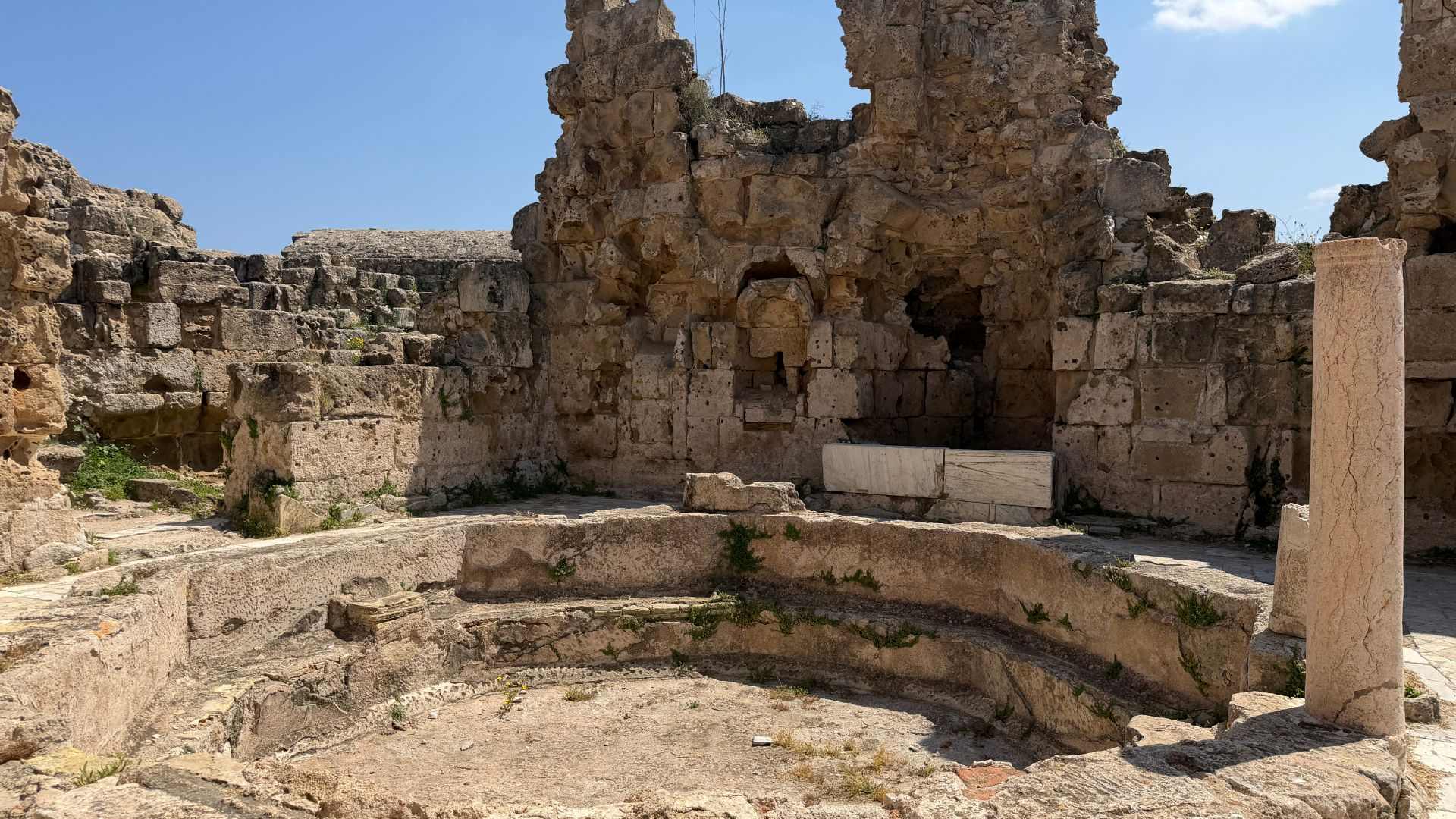
The first major complex you reach, and the most photographed part of Salamis. The gymnasium centres on a colonnaded exercise court, the palaestra, ringed by marble columns, many re-erected by archaeologists.
Around it sit the bath buildings with their heated rooms, cold plunge pools and a striking communal latrine.
Look for the surviving mosaic fragments tucked under the arches, easy to walk straight past if you do not know to look for them.
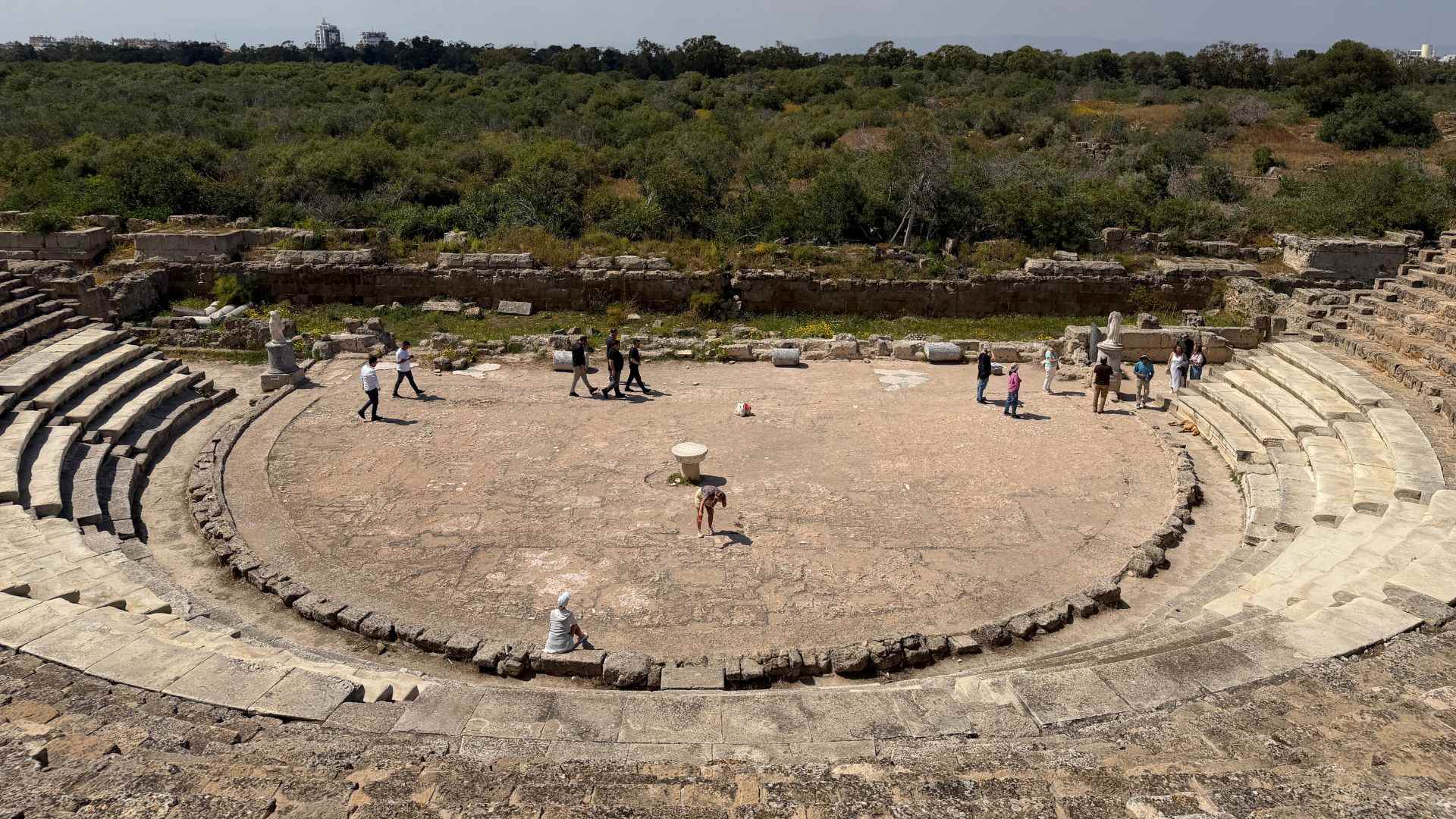
A short walk south of the baths. The Roman theatre dates to the reign of Augustus and was completed under Trajan and Hadrian. It originally had 50 rows of seats and could hold over 15,000 spectators, though only the lower rows survive today.
The lower rows are intact enough to sit on, and the acoustics still work. It is occasionally used for summer performances.
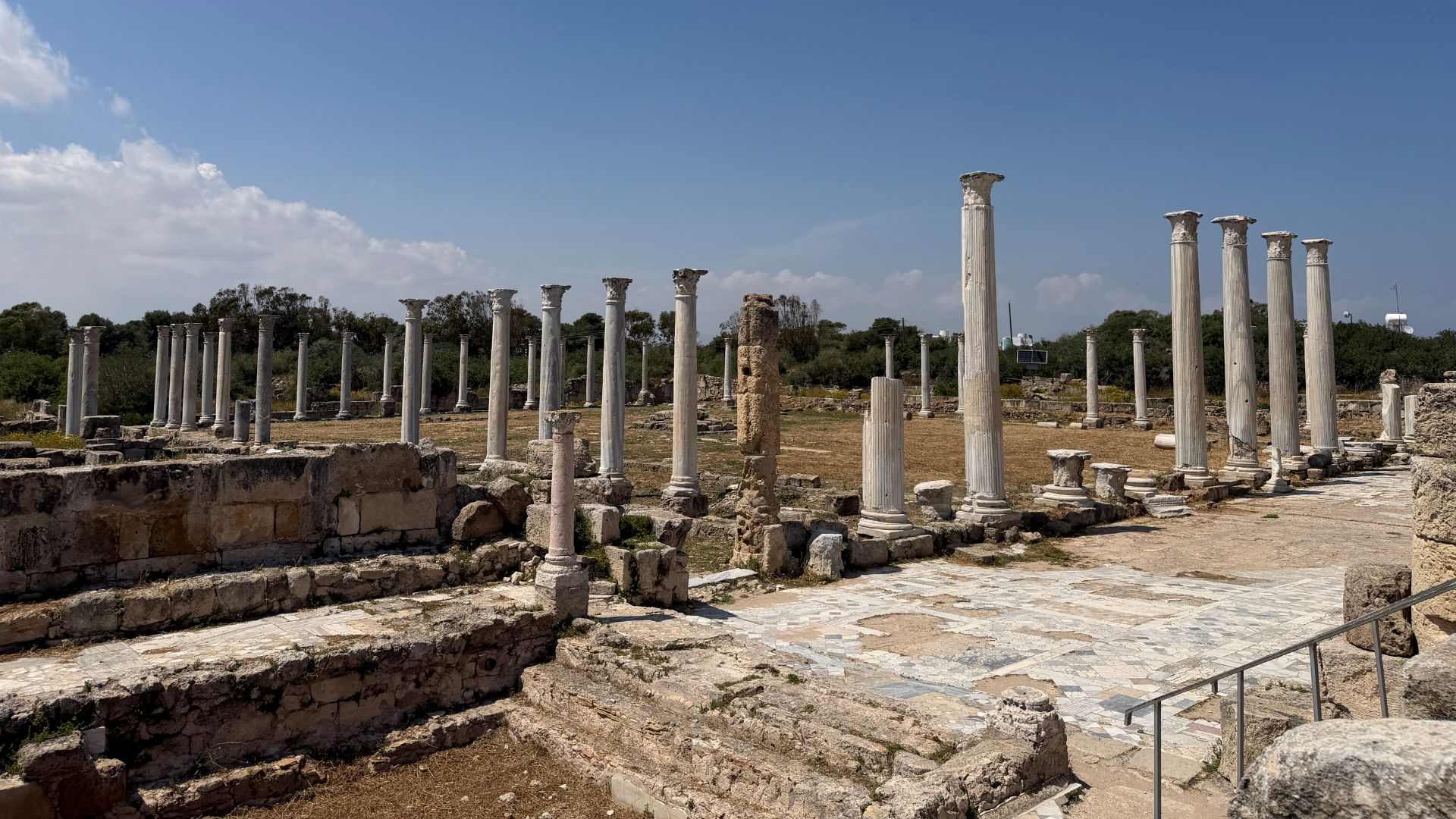
Further south lies the vast Roman agora, the city’s marketplace, along with the remains of the Temple of Zeus Olympios at its far end.
This part of the site is more ruined and less visited, but it gives the clearest sense of the sheer scale of the ancient city and is well worth seeing.
Salamis has two important early Christian churches. The Basilica of Agios Epiphanios, built around AD 400 as the metropolitan church of Salamis, was once the largest basilica on Cyprus, measuring roughly 58 by 42 meters.
The Kampanopetra Basilica sits near the coast at the northern end of the site, in a fine position above the sea.
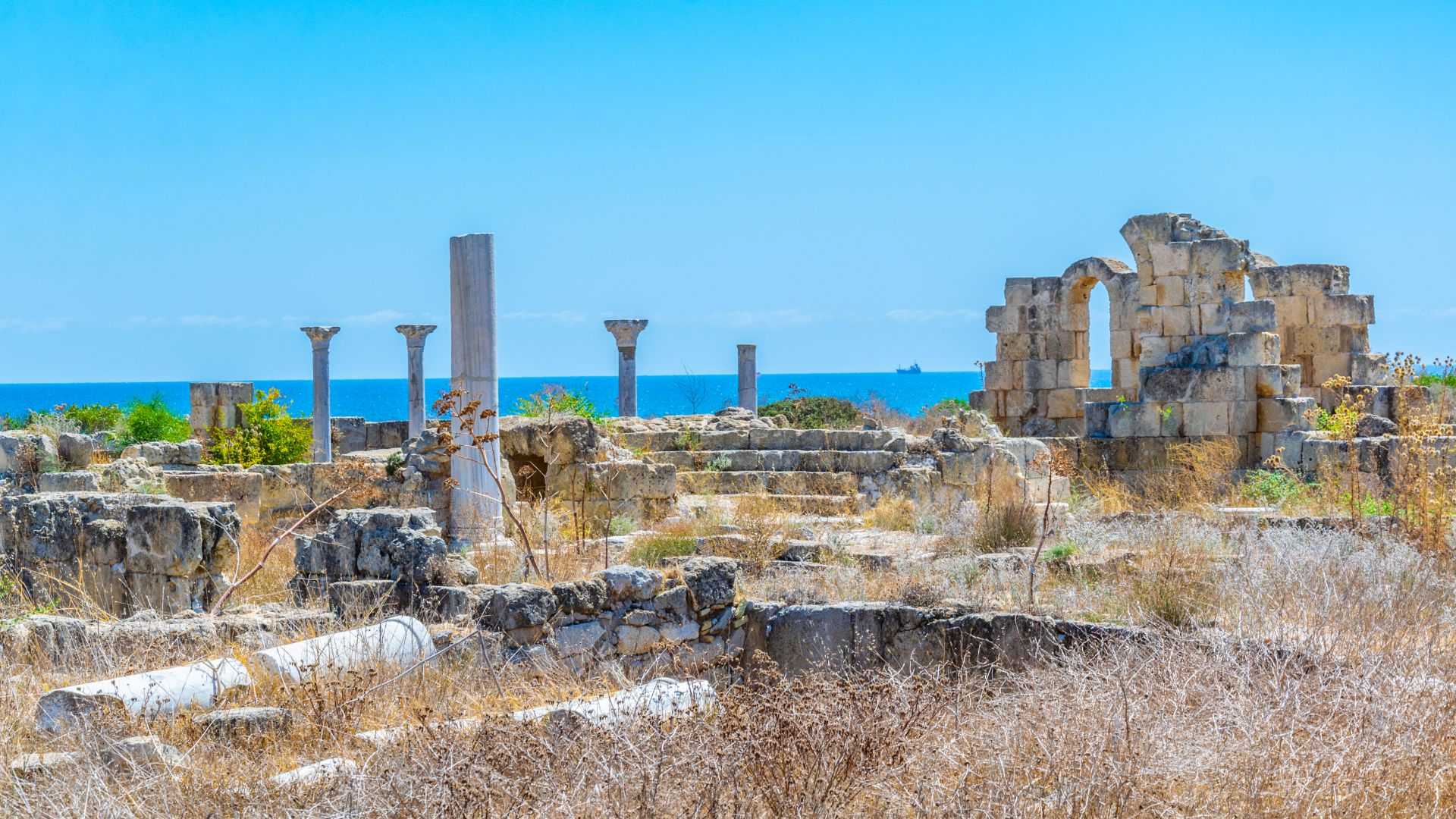
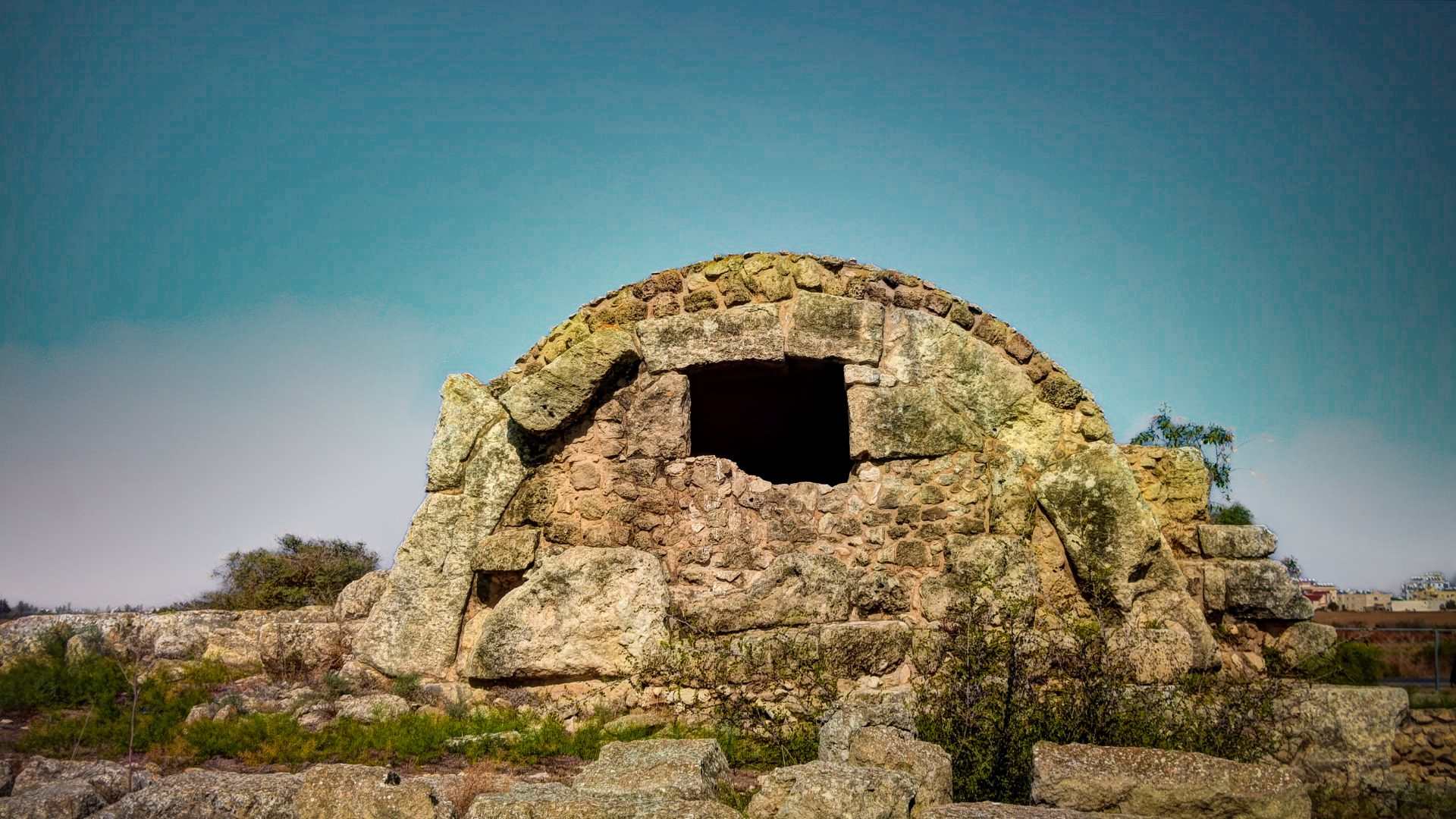
A huge vaulted Byzantine cistern and stretches of the ancient pillared road survive, giving a real feel for the city’s infrastructure and water supply, which was fed by an aqueduct from Kythrea.
West of the main site, across the main road, are the Royal Tombs, monumental burials dating from around the 8th to 7th century BC. One famous grave contained a chariot buried with its horses and grave goods imported from Egypt and Syria.
There is a small museum here. Note that this is a separate area from the main ruins.
Not many people venture to the Tombs as the Gymnasium is undoubtedly the most impressive site, followed by the Roman Baths and the Theatre, which are all close to the entrance of the Archaeological Park.
Salamis is open daily. Expect roughly 8:00 to 18:00 in summer, with shorter hours in winter. Hours shift seasonally, so treat these as a guide and confirm locally.
The entry fee is low, but it is charged in Turkish lira, and the euro equivalent moves with the exchange rate. Currently, it’s 50 TL, which is about €3 and can be paid by card if you don’t have TL.
I’ve occasionally not been charged at all when I come alone or with one other.
Allow two hours for the main site. Three to four hours if you want the tombs, the outlying basilicas, and time to read the signage. An hour in a pinch.
The site is 10 km north of Famagusta, 15 minutes by car. A car is by far the easiest way to visit.
Public buses run along the coast road towards Iskele, and can drop you near the site, but the timetable is thin, worse on Saturdays, and there are no buses on Sundays, so check before you rely on it.
Salamis is in Northern Cyprus, so you will cross the Green Line to reach it. A few things catch travelers out:
🚙 If you are driving, your Republic of Cyprus car insurance does not cover the north. You need separate insurance for Northern Cyprus, bought at the crossing, and many rental companies prohibit taking their cars across at all. Check with your rental agency first.
✈️ If you enter Cyprus through a northern airport or port, you may be treated as having entered the island illegally by the Republic of Cyprus. Always enter through a Republic of Cyprus airport first if you intend to leave the island through the Republic.
🛂 Carry your passport (or EU ID card if you are an EU citizen) for the crossing.
The Deryneia crossing near Famagusta is the most convenient if you are heading to Salamis and the east coast. The full breakdown of checkpoints, hours and car rules is in our Essential Guide to Crossing the Green Line in Cyprus.
There is very little shade on site, and the walk is over uneven stone and dust. Bring water, a hat, sunscreen, and closed shoes. In summer, go early morning or late afternoon to avoid the worst heat and get the best light on the stone.
During the year, the site is maintained unevenly. If you’re lucky, you’ll visit when the grass has been cut, and the bushes pruned and cut back from the paths. The first part of the site is easy. Beyond the theatre, and on the dusty road out to the further parts of the site, the going is easy. If you leave the path and head through tall grass (which can be as high as your head), tread carefully because of snakes.
And whilst the semi-domesticated puppies are cute, they really scratch my legs!
Yes. Salamis is the largest and most extensive ancient city site on Cyprus, and because it sits in the less-visited north, it is often remarkably quiet compared with the busier sites in the south.
It is worth knowing that Cyprus has three UNESCO World Heritage Sites, all in the south: the Paphos archaeological area, Neolithic Choirokoitia, and the Painted Churches of the Troodos region. Salamis is not on that list, but as a single ancient city to walk through, few sites on the island match its scale.
You get a Roman theatre, a full bath and gymnasium complex, Byzantine churches and a marketplace, all strung along an empty Mediterranean coastline. For anyone interested in ancient history, it rewards a half day easily.
The one thing to plan around is the crossing and the logistics of the north. That is exactly where a guided visit removes the friction.
If the crossing, the car insurance, the timings and the sheer size of the site feel like a lot to organise, this is a place where an expert-led visit genuinely changes the experience. On our Archaeological Treasures of Cyprus tour, we cross the buffer zone into Northern Cyprus and meet a local archaeologist for a private tour of Salamis, then continue to Famagusta and the other great sites of the north.
Salamis also features on our Cyprus and Malta tour, which pairs the island with the megalithic temples of Malta. Either way, a guided visit removes the border logistics entirely and puts the ruins in the hands of someone who can read them for you.
I couldn’t imagine a visit to Cyprus without visiting the Ancient city of Salamis and the nearby monastery of St. Barnabas. The site reminds me of the power of Cyprus’ ancient ports and the enormous influence of the Romans upon many of the islands of the Mediterranean. I try to visit in Spring, when the wildflowers abound throughout the site.
Salamis rewards curiosity. Come with a little history in your head, give it a half day, plan the crossing properly, and you will understand why this quiet stretch of coast was the beating heart of ancient Cyprus for more than a thousand years.
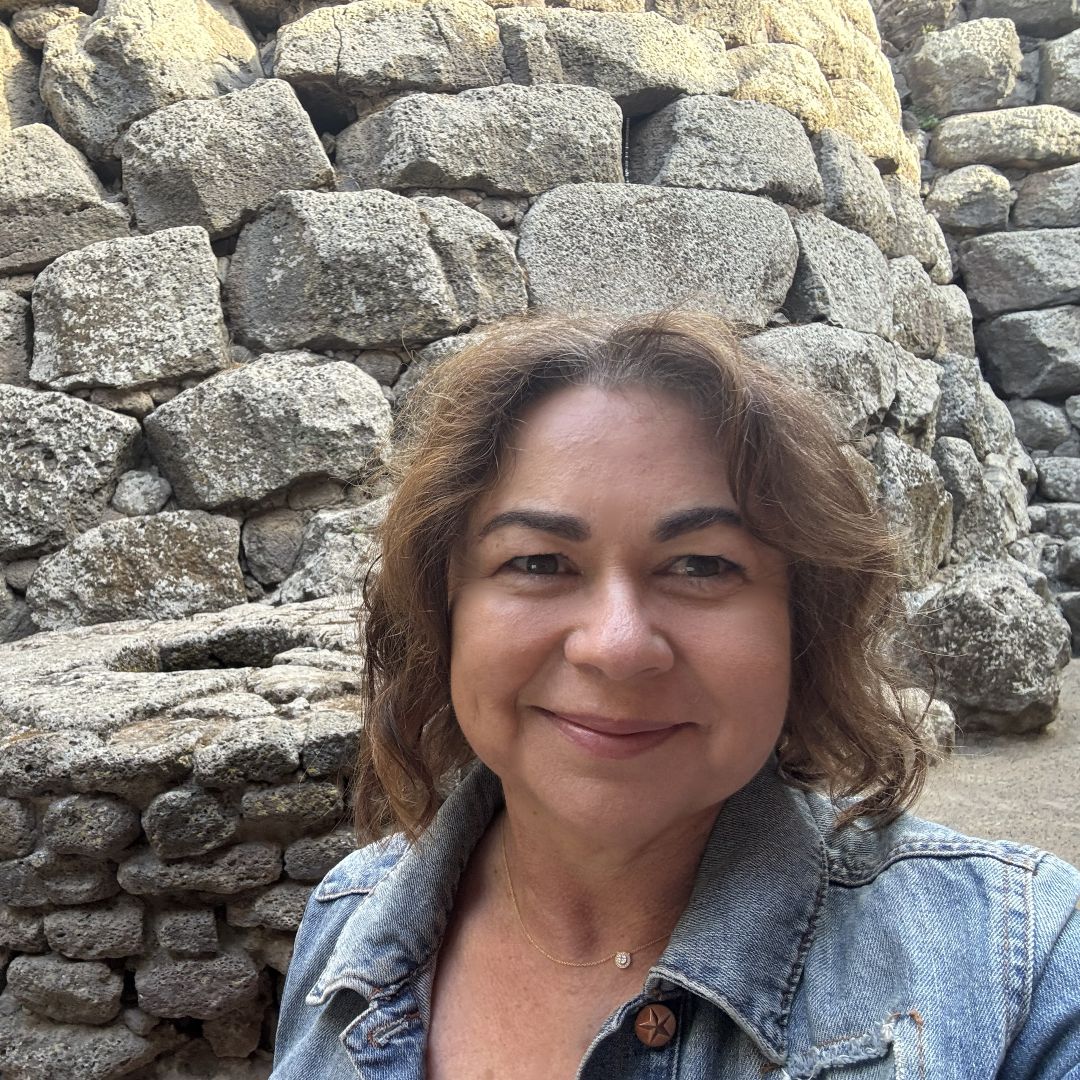
Professor Monique Skidmore is an award-winning anthropologist and travel expert who has spent more than 25 years exploring and documenting cultures around the world. As the founder of Take Me To Europe Tours, she combines her deep academic expertise with a passion for cultural immersion and archaeology. Monique creates small-group journeys across Cyprus, Greece, Italy, Malta, and the wider Mediterranean.
On her small‑group Cyprus tour, she visits Ancient Salamis, and this guide draws on those visits as well as her own independent travels in and around Cyprus.
For more on her work and travels, visit her About Monique page.

Free 16-page guide
Written by archaeologists. Submerged Roman villas, underground cities and abandoned Greek quarries –, with maps, access details and what to see at each.
One email a week. Unsubscribe anytime.
Free 16-page guide
Written by archaeologists. Submerged Roman villas, underground cities and abandoned Greek quarries –, with maps, access details and what to see at each.
One email a week. Unsubscribe anytime.