
Athenian democracy lasted roughly 250 years, from Cleisthenes’ reforms in 508 BC to the Macedonian conquest under Philip II in 338 BC. That is approximately the same span of time that has elapsed since the American Revolution and the drafting of the modern world’s founding democratic constitutions. The parallel is not rhetorical but structural. We are living at a point in democratic history that Athens has already been through, and Athens did not survive it.
In partnership with the Mycenaean Foundation, our 6-day tour of Athens and Attica traces the story of Athenian democracy from its political and civic origins through its cultural, military, and technological dimensions. Led by distinguished archaeologist and President of the Mycenaean Foundation, Professor Christofilis Maggidis, we explore the foundational sites of Western democracy in the context of how Classical Athens shaped the institutions and ideas that still underpin modern governance.
Throughout the tour, Professor Maggidis examines both sides of that history: the specific conditions that made Athenian democracy possible (civic participation, institutional design, economic foundations, military organization, and a culture of public argument) and the pressures that eroded and ultimately ended it. Demagoguery, imperial overreach, inequality, factionalism, and the concentration of military power all played their part. The battlefield at Marathon, the silver mines of Lavrion that funded the Athenian fleet, the Pnyx where citizens cast their votes, and the Temple of Poseidon at Sounion each add a different dimension to that story. Athens has no shortage of tours through its UNESCO monuments, but this is the only one that uses the wider landscape of Attica as evidence for a single, urgent question: what does democracy need to survive, and what causes it to fail?
The tour is balanced throughout with the pleasures of contemporary Greece. We stay in an elegant 4-star boutique hotel in the heart of historic Athens, eat and drink well across Athens and Attica, and visit the city’s finest archaeological, technology, and military museums. The week closes with a farewell dinner on the Athenian Riviera at Sounion, combining the tour’s final site visit with one of the most spectacular coastal settings in Greece.
Should you have any questions about this tour, please don’t hesitate to get in touch with our team.
Price Includes
Price Excludes
Professor Maggidis, President of the Mycenaean Foundation, Field Director of the Lower Town excavations at Mycenae and a resident of Athens, guides you through every site. Warm and delightful company, his intelligence and gentle manner are a highlight of the tour.
We tour in spring and fall to avoid the summer crowds at the Acropolis and the Temple of Poseidon at Sounion.
There is time to wander Kolonaki, Plaka and Monastiraki, and to linger over lunches and dinners of regional specialties.
With a maximum of 12 guests, conversation comes easily over local wine and Attic food.
Each evening, we return to our boutique hotel in the heart of historic Athens.
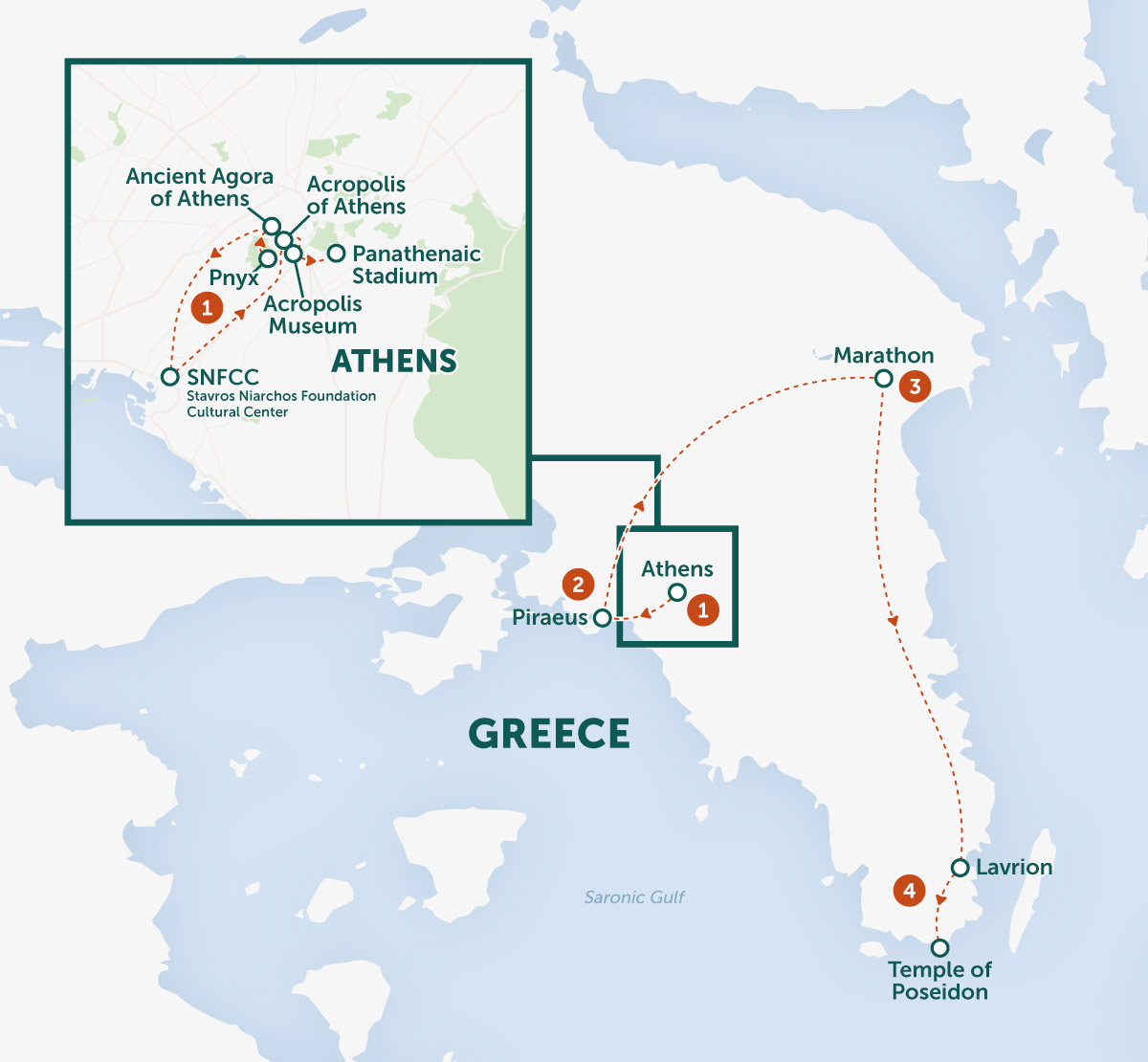
Our tour begins in the heart of modern Athens, where ancient ideals still resonate through a vibrant capital. On an introductory walk, we watch the ceremonial Changing of the Presidential Guard in front of the Monument of the Unknown Soldier at Constitution Square, then stroll through the National Gardens to the Temple of Olympian Zeus. The sons of the tyrant Peisistratos began it around 520 BC, and the Roman emperor Hadrian finished it in AD 132. Along the way, you see the enduring relationship between Greece’s classical heritage and its modern identity.
We follow our walk with a wonderful local dinner with wine.
Meals: D
Overnight: Athens
Our archaeologist-guide leads us on a private tour of the foundations of democratic governance. We stand on the Pnyx, where Athenian citizens assembled to debate and vote, and some decisions needed 6,000 of them present. We walk through the Ancient Agora, the political and commercial heart of the city, where Socrates questioned his fellow Athenians.
The remarkable Phaleron Bound Men, shackled skeletons of the 7th century BC that some scholars link to Cylon’s failed coup, offer a powerful perspective on the political struggles that preceded democracy. The optional evening lecture examines the emergence, principles, achievements and challenges of democratic government, drawing parallels between ancient Athens and the modern world.
Meals: B, L, D
Overnight: Athens
Today, we give ourselves over to the astonishing ruins atop the Acropolis of Athens, its museum and the Panathenaic Stadium. The Parthenon, built between 447 and 432 BC, was paid for partly from the treasury of the Delian League, and the Acropolis Museum reveals how architecture and public art expressed the ideals of the democratic polis. The Panathenaic Stadium, rebuilt in marble for the first modern Olympic Games in 1896, reflects the importance of athletic competition in civic life.
Join us for an optional pre-dinner discussion on Greek tragedy and comedy, which illustrates how theater served as a public forum where citizens examined justice, leadership and morality, and satirized their leaders.
Meals: B, L, D
Overnight: Athens
Today we go rowing! The strength of Athens rested on its economic prosperity, technological ingenuity and maritime supremacy. You step into a full-size replica of an ancient trireme, pick up an oar and row, to discover how 170 rowers powered the warships that secured Athenian dominance of the Aegean.
Returning to Kolonaki, we explore remarkable inventions in the Museum of Ancient Greek Technology. After a leisurely meal with wine at a Kolonaki taverna, we head off to the National Archaeological Museum, home of the Antikythera Mechanism, often called the world’s oldest known computer.
A pre-dinner optional lecture on the Greco-Persian Wars shows how military victory safeguarded the democratic experiment.
Meals: B, L, D
Overnight: Athens
On our final full day, we examine how Athens defended both its independence and its democratic ideals. Visits to the War Museum, the battlefield of Marathon, the ancient silver mines of Lavrion and the magnificent Temple of Poseidon at Sounion, built about 440 BC, reveal the military, economic and strategic foundations that sustained Athenian power. At Marathon in 490 BC, the Athenians and their Plataean allies defeated a much larger Persian army. Lavrion’s silver paid for the fleet that beat the Persians again at Salamis in 480 BC.
A farewell dinner overlooking the Athenian Riviera offers an opportunity to celebrate an unforgettable journey through the birthplace of Western political thought.
Meals: B, L, D
Overnight: Athens
After our last breakfast together, we take a group transfer to Athens International Airport.
It’s farewell to Athens for now, but we hope to see you again on tour with us soon.
Meals: B


Professor Christofilis Maggidis is a leading Mycenaean and Aegean Bronze Age archaeologist who has personally excavated at Mycenae for over two decades. He holds a Ph.D. in Classical Archaeology from the University of Pennsylvania, earned with the support of Fulbright and other distinguished fellowships, and currently serves as Field Director of the Lower Town Excavation at Mycenae, which he has led since 2001, and the Spercheios Valley Archaeological Project.
He founded and chaired the Department of Archaeology at Dickinson College, and now teaches graduate courses on ancient democracy, warfare, and diplomacy at the Institute of World Politics in Washington, D.C., a perspective that shapes how he guides travelers through Athens today. As President of the Mycenaean Foundation, he has spent over a decade building the institutions that support Greek archaeology for the next generation.
But ask anyone who has walked the Acropolis or the Agora with him, and they’ll tell you it never feels like a lecture. He has a gift for turning the stones beneath your feet into stories, the kind of guide who makes you feel like you’re exploring Athens with a brilliant, generous friend rather than touring it. Read Christofilis’s full biography on our About page.
Our tours are physically active! Clambering around archaeological sites, castles, acropolises, and fortresses is an essential part of the Take Me To Europe tour experience, and stairs are everywhere in Europe! That said, this is one of our least demanding tours.
On our Cradle of Democracy: Ancient Athens Tour, you will need to be able to:
Free 16-page guide
Written by archaeologists. Submerged Roman villas, underground cities and abandoned Greek quarries –, with maps, access details and what to see at each.
One email a week. Unsubscribe anytime.


