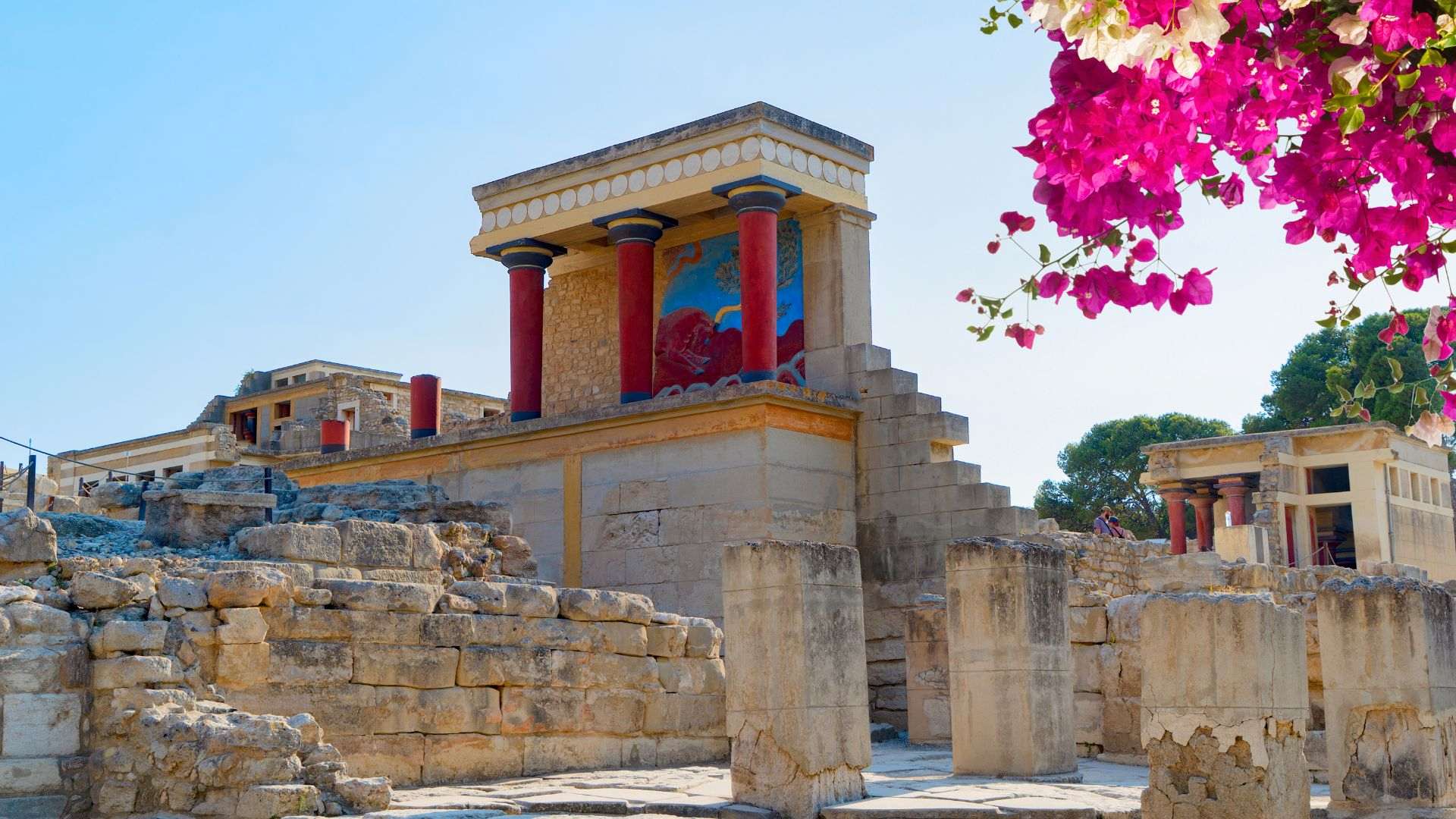
Beneath the sprawling Palace of Knossos, the legend goes, Daedalus built the labyrinth where King Minos kept the Minotaur. Our Minoan Crete tour follows the real civilization behind the myth, guided by specialist Minoan archaeologist Dr. Elena Soulioti. We begin in Athens at the National Archaeological Museum, home to Greece’s most spectacular treasures and the wonderful frescoes of Akrotiri, then fly to Crete, the birthplace of the Minoan civilization.
We follow Crete’s northern and southern shores, from the Venetian harbors of Chania and Rethymno to Phaistos and Gortyna on the sun-drenched Mesara plain. We peer down into the labyrinth at Knossos and behold the stupendous frescoes and relics of the Heraklion Archaeological Museum. We then venture east to the remote palace of Zakros, cross to Minoan Mochlos, and return by the fortress isle of Spinalonga and the palace of Malia. Evenings bring Cretan feasts and the living rhythms of local life.
A high-speed ferry then takes us to the dazzling cliffs of Santorini for two magical days: the Bronze Age city of Akrotiri, the flavors of Cycladic wine country and the iconic Santorini sunset from a caldera cruise.
Should you have any questions about this tour, please don’t hesitate to get in touch with our team.
Price Includes
Price Excludes
On our expert-led Greek archaeology tours, you explore alongside a distinguished archaeologist who brings depth to every site visit. On this tour, specialist Minoan archaeologist Dr. Elena Soulioti is also your tour leader, so your journey through Minoan Greece is both enlightening and seamless.
By touring in October, we avoid the crush of summer crowds at UNESCO World Heritage sites such as the Palace of Knossos, so you can fully appreciate the magnificent monuments. We also tour lesser-known sites such as Phaistos, Gortyna and Zakros, away from most of Crete’s tourists. Our itinerary balances archaeology with leisure time, with opportunities to wander the historic streets of Oia, Rethymno, Chania and Heraklion. With just 12 guests, we share engaging conversations over excellent local wines and Greek regional cuisine, and each evening we return to boutique hotels chosen for their sense of place.

Our Minoan Crete tour begins in Athens. After your private transfer from the airport to the hotel, we warmly welcome you to central Athens with welcome drinks, followed by a wonderful local dinner with wine and beer.
Meals: D
Overnight: Athens
We start our day at the National Archaeological Museum, the largest archaeological museum in Greece. Here, our expert guide gives us an overview of Greece’s main historical periods, so that we understand the place of the Minoan civilization within the great theater of Greek history. We marvel together at the wall paintings from Akrotiri before we see the ancient town itself on Santorini.
Later, we transfer to the airport for our flight to Chania, Crete, where we settle in and dine as a group with the Cretan Sea close by.
Meals: B, L, D
Overnight: Chania
We head together to the Archaeological Museum of Chania and its impressive collection of Minoan finds from western Crete: bird-shaped vessels, seal stones, pottery and artifacts from ancient Kydonia, Armenoi and more. Kydonia lies beneath Chania itself and is one of the six Minoan palatial centers inscribed by UNESCO in 2025.
Elena is particularly excited to show us the Seal of the Master, an incredible representation on a tiny clay sealing of the city of Chania viewed from the sea, dating to the 15th century BC, as well as an entire Minoan lustral basin. We then begin a guided walking tour of Chania’s Venetian harbor and storied old town. The rest of the day is free to wander or relax by the harbor.
Meals: B, L
Overnight: Chania
We journey on to Rethymno, stopping first at the evocative Armenoi Minoan Cemetery, one of the most important Late Minoan burial grounds in Crete. Its more than 230 tombs held pottery, jewelry and painted clay sarcophagi, a rare window into the burial customs, social structure and daily life of the Minoans in the Bronze Age.
After checking into our Rethymno hotel, a palazzo from the Venetian rule of Crete (1211 to 1669), we explore the old town, a traditional filo workshop and Rethymno’s lively harbor. Tonight you are free to sample local cuisine in the atmospheric alleyways around our palazzo.
Meals: B, L
Overnight: Rethymno
Today we journey through the scenic countryside, stopping first at Arkadi Monastery. In 1866, during the Cretan revolt against Ottoman rule, the people sheltering here blew up the monastery’s powder magazine rather than surrender, and Arkadi became a lasting symbol of Cretan freedom.
Our next destination stands at the crossroads of Cretan history: ancient Eleutherna. Its roots reach back to the Minoan period, and the pottery, figurines and sacred objects in its museum show how Minoan artistry left a lasting impression on later Cretan civilization. We lunch in Margarites, a village celebrated for its pottery workshops, with time to wander among the potters before returning to our Rethymno palazzo. Tonight, dinner is a traditional Cretan meal with wine along the waterfront.
Meals: B, L, D
Overnight: Rethymno
We set out to discover the palatial ruins of Phaistos, the second largest Minoan palace and one of the greatest cities of Minoan Crete. Phaistos is renowned for its monumental palace, its stunning views over the Mesara plain, and the celebrated Phaistos Disc and Linear A inscriptions found here, key artifacts in unraveling the mysteries of Minoan writing.
We then continue to Gortyna, later the Roman capital of Crete. Here we see the laws inscribed on a wall in the center of the ancient city around 450 BC. They are the oldest surviving law code in Europe, with detailed references to marriage, property, inheritance and daily life. We then head north to Heraklion and share stories over a group dinner.
Meals: B, L, D
Overnight: Heraklion
Today we discover the world-class Minoan collections of the Heraklion Archaeological Museum, one of the finest assemblies of Minoan artifacts anywhere, where the Phaistos Disc, vibrant frescoes and ceremonial objects open a window into Minoan society, art and daily life.
Then it’s onward for our private tour of the fabled Palace of Knossos, one of Europe’s largest Bronze Age sites, covering about six acres with more than a thousand rooms, courtyards and storerooms. Its maze of rooms is thought to lie behind the myth of the Labyrinth, and in 2025 Knossos was inscribed on the UNESCO World Heritage List as part of the Minoan Palatial Centres. Dinner tonight is at your leisure in the tavernas of central Heraklion’s vibrant squares.
Meals: B, L
Overnight: Heraklion
We farewell Heraklion for now and journey east on our longest travel day (about 4 hours) to remote Zakros. We love this wild part of Crete, and few tours make the journey. The Palace of Zakros was the Minoan gateway for trade with Egypt and the Near East, and when Nikolaos Platon found it in 1961, it was the only Minoan palace that had never been looted.
We will have seen its treasures the day before in the Heraklion Museum, including imported luxury goods, Linear A tablets and ritual objects. After exploring the haunting ruins, we relax at Kato Zakros Beach and enjoy a tranquil evening in this coastal village.
Meals: B, L, D
Overnight: Zakros
We journey northwest to Mochlos harbor, where we board small fishing boats across the turquoise channel to tiny Mochlos Island. In Minoan times it was joined to Crete by a narrow neck of land that gave the town two sheltered harbors. Together we explore its extensive Minoan ruins: house blocks, workshops and tombs that held exquisitely crafted gold jewelry and pottery. These finds reveal Mochlos as a hub of craftsmanship, trade and maritime connections.
After lunch, we drive on to Elounda, our base for the evening, to enjoy the beach, port and village after our journey to remote eastern Crete. We come together again for an authentic Cretan meal with wine.
Meals: B, L, D
Overnight: Elounda
We board the ferry to Spinalonga, the fortress island just offshore. The Venetians fortified it in 1579, and from 1903 to 1957 it was one of the last active leper colonies in Europe, a history immortalized in Victoria Hislop’s best-selling novel The Island. Its homes, ramparts and streets evoke both the suffering and the resilience of those exiled here.
After a last lunch in Elounda, we explore the Minoan Palace of Malia, the third largest Bronze Age palace in Crete, with courtyards, granaries, workshops and ceremonial spaces nearly 4,000 years old. Finds from Malia include the extraordinary gold bee pendant we saw in the Heraklion Museum, and inscriptions in all three Bronze Age scripts of Crete: Cretan Hieroglyphic, Linear A and Linear B. We return to Heraklion for our final evening in Crete, free to choose your own taverna for dinner.
Meals: B, L
Overnight: Heraklion
We’re up early to board a high-speed ferry for dazzling Santorini. In Fira, our archaeologist guide takes us on a private tour of the Museum of Prehistoric Thera, where finds from Akrotiri show life on the island before the great eruption. We then check into our traditional white sugarcube accommodation. The rest of the day is yours to wander the magical villages along the caldera rim. We come together in the evening for a memorable sunset dinner overlooking the caldera.
Meals: B, D
Overnight: Oia
Our final day together in Santorini begins at the Bronze Age city of Akrotiri, a thriving port deeply connected to Minoan Crete through trade and shared artistry. The volcanic eruption of around 1600 BC buried it in ash, preserving multistory houses, vivid wall paintings and an advanced drainage system, which is why it is called the Minoan Pompeii.
Next, we visit Santorini’s volcanic-soil vineyards, where indigenous grape varieties thrive in mineral-rich, ashy earth, and savor tastings of unique local wines. As sunset nears, we board our boat for a cruise around the caldera, with our farewell dinner served on board, and reflect on our shared journey through the Minoan world and our newfound friendships.
Meals: B, L, D
Overnight: Oia
We savor our final breakfast together before private transfers to Santorini Airport or the ferry port. We each carry home the secrets of the Labyrinth and the genius of the ancient Minoans. If you’d like to (understandably) stay longer on this enchanting island, we’ll be happy to help you extend your stay.
Meals: B


Dr. Elena Soulioti is a specialist in Aegean Bronze Age and Minoan archaeology with a PhD from Durham University on the social role of Minoan symbols. For more than 25 years she has combined cutting-edge research with inspiring on-site storytelling as a licensed Greek tour guide throughout mainland Greece and the islands. Since the late 1990s she has guided in Greek, English, Spanish and German, designing specialist tours for universities, alumni groups, schools and cultural associations.
Her research focuses on material culture, symbolism and religious practice in Bronze Age Aegean societies, especially the Minoans, and she has presented at international conferences in Greece and the UK on topics such as Minoan religious symbols and the “sacred knot.” Her fieldwork includes major Minoan sites across Crete, with three seasons at the Palace of Zakros, studies at the Makrygialos Minoan Villa and extensive work on unpublished pottery in the museums of Heraklion and Aghios Nikolaos.
Elena’s tours are known for clear, engaging narratives that connect archaeological evidence with myth, philosophy and everyday life. Guests often say she weaves complex ideas into vivid stories that make sites feel alive without overwhelming them with jargon. Read more about Elena on our About page.
Our small-group guided tours are physically active. Clambering around archaeological sites, castles, acropolises and fortresses is part of the Take Me To Europe experience, and Europe has stairs everywhere. On our Minoan tour, we have had to make decisions based on the distances involved, because Crete is a big island!
We have chosen more nights in different villages and cities so that we spend as little time on the road as possible. This means plenty of packing and unpacking, and rolling your bag between the minibus and hotels, airports and ferry terminals, so please pack as lightly as you can. Just remember to pack your curiosity: it doesn’t need to go in your suitcase!
You will need to be able to:
Free 16-page guide
Written by archaeologists. Submerged Roman villas, underground cities and abandoned Greek quarries –, with maps, access details and what to see at each.
One email a week. Unsubscribe anytime.