The Pantheon is one of the world’s most iconic and best-preserved ancient buildings — and visiting it is an unmissable experience on any trip to Rome. In this guide, you’ll find everything you need to know: tickets, opening hours, dress code, history, and what to see inside.
I’m a cultural anthropologist and certified Italy travel specialist, and I still remember the first time I bumped into the back wall of the Pantheon without even realising what it was — other than something very, very old. Since that first unplanned encounter, I’ve visited each time I’ve returned to Rome. It has an ancient, monumental presence that keeps drawing me back.
Planning a trip to Rome?
We specialise in custom-designed Rome itineraries and small-group history tours throughout Italy. Whether you’re a first-time visitor or a seasoned traveler, we’ll build you a trip that goes beyond the surface.
The Pantheon’s address is: Piazza della Rotonda, 00186 Roma RM, Italy
It sits in the heart of Rome’s historic centre, surrounded by cafes, gelaterias, and the beautiful Fontana del Pantheon in the piazza. It’s an easy walk from many of Rome’s other major attractions.
Getting there by public transport:
🚊Tram: Line 8 to Piazza della Rotonda
🚌Bus: Lines 40, 46, 62, 64, and several others stop nearby
🚶♀️On foot: The Pantheon is best reached by walking from most central Rome hotels — the historic centre is compact and very walkable
🚆 Note on the Metro: The nearest metro stops are Barberini (Line A) and Spagna (Line A), but both are a 15–20 minute walk away. The bus or tram is a better option if you’re not already nearby.
🚏The most convenient way to get between the Pantheon and other major sights is the Rome: Big Bus Hop-on Hop-off Sightseeing Tour, available with 24, 48, and 72-hour tickets.
The Pantheon is open daily from 9:00 am to 7:00 pm (last entry 6:45 pm).
Closed on: January 1, August 15, and December 25.
Note that the Pantheon is still an active Catholic church, so it may occasionally close or have restricted access during religious services.
🎫 The Pantheon is no longer free to enter. Since July 2023, a general admission fee applies:
| Visitor Type | Price |
|---|---|
| Adults (non-EU) | €5 |
| EU citizens aged 18–25 | €2 |
| Children under 18 | Free |
| Rome residents | Free |
| First Sunday of the month | Free |
Tickets can be purchased at the door or booked in advance online. Booking in advance is strongly recommended in summer and during peak tourist season.
The sanest — and most enriching — way to visit the Pantheon, especially in summer when crowds are enormous, is with a guided tour. Here are the best options:
🎟️ #1 Top Pick — Rome: Small-Group Pantheon Guided Tour with Entry Ticket
The only Pantheon tour with a perfect all-5-star rating. This 50-minute small-group tour includes a personal headset, skip-the-line entry, and expert commentary. Ideal for summer visits.
🎟️ #2 Budget Pick — Rome: Pantheon Priority Entry Tickets with Interactive App
At around $5, this entry ticket is booked hundreds of times a day. A great option if you prefer to explore at your own pace.
Want more than just the Pantheon?
Our Italy History Tours take you deeper into Rome’s ancient world — from the Colosseum to the Roman Forum and beyond. Or let us build a custom Rome itinerary tailored entirely to your interests, pace, and travel style.
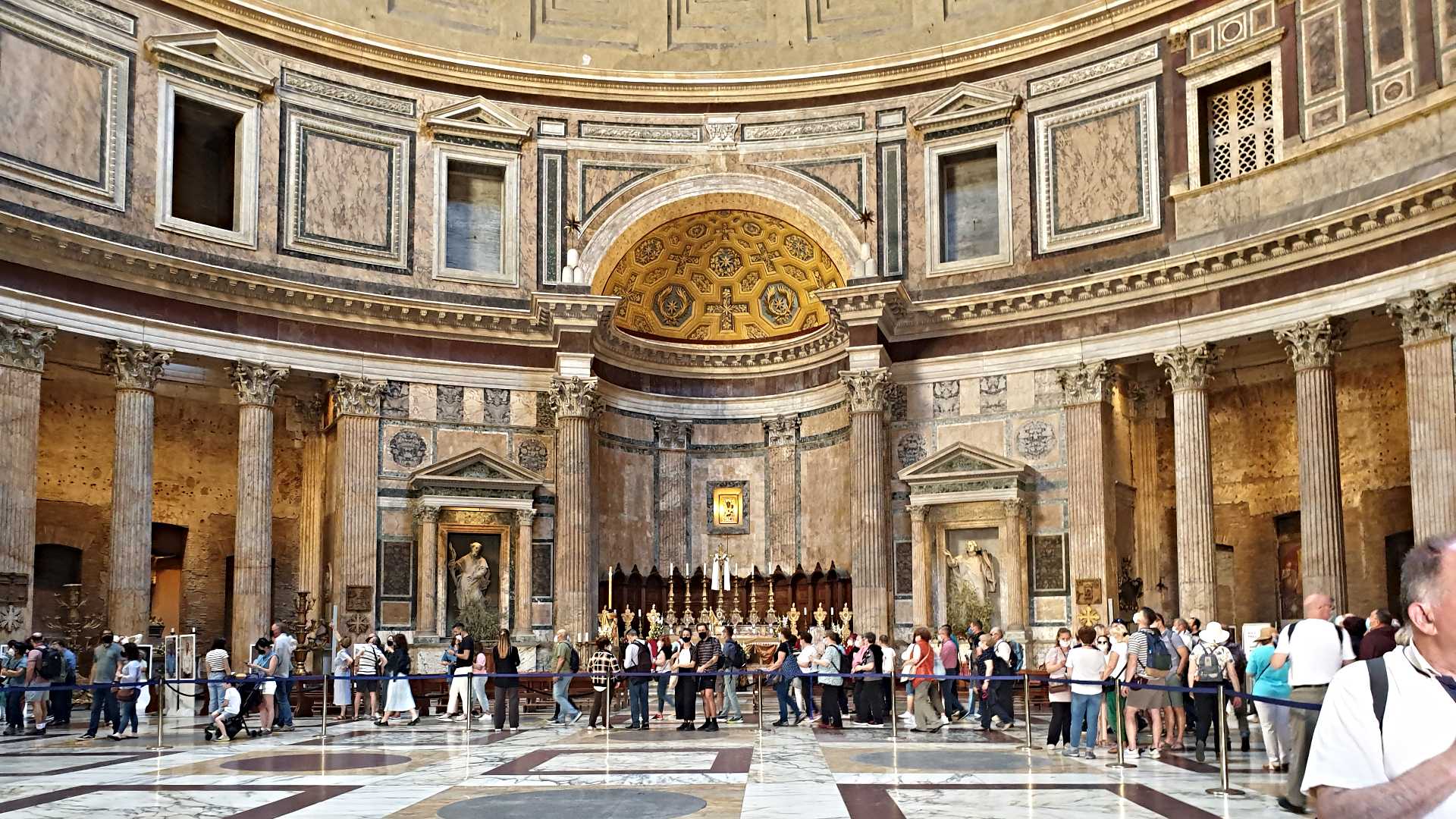
As an active Catholic church, the Pantheon enforces a strict dress code. Visitors who do not comply may be refused entry.
You must:
✅ Cover your shoulders (no sleeveless tops or strapless dresses)
✅ Cover your knees (no short shorts or miniskirts)
You must not wear:
❌ Hats inside the building
❌ Flip-flops or beachwear
❌ Clothing with offensive slogans or imagery
If you’re visiting in summer and have bare shoulders, carry a scarf or light cardigan to put on at the entrance. It’s worth planning ahead — being turned away at the door is a frustrating experience.
🔶 Early morning (9:00–10:00 am) is the least crowded time and ideal for photos — the light through the oculus is stunning at this hour
🔶 Avoid midday in summer — queues can stretch across the entire piazza
🔶 Weekdays are quieter than weekends
🔶 Visit on the first Sunday of the month if you want free entry, but expect larger crowds
🔶 Spring (April–May) and autumn (September–October) offer the best balance of good weather and manageable crowds
Most visitors spend 30–60 minutes inside. A guided tour runs 45–50 minutes. Allow extra time to explore the Piazza della Rotonda outside — it’s a beautiful spot to sit with a coffee and take in the surroundings.
None less than Michelangelo described the Pantheon as “the work of angels,” and it has often been called the eighth wonder of the ancient world. So what makes it so extraordinary?
Despite being nearly 2,000 years old, the Pantheon looks as complete and sturdy as many neoclassical buildings constructed in its image centuries later. Its design has been imitated by the rich and powerful ever since — from the US Capitol to the Panthéon in Paris.
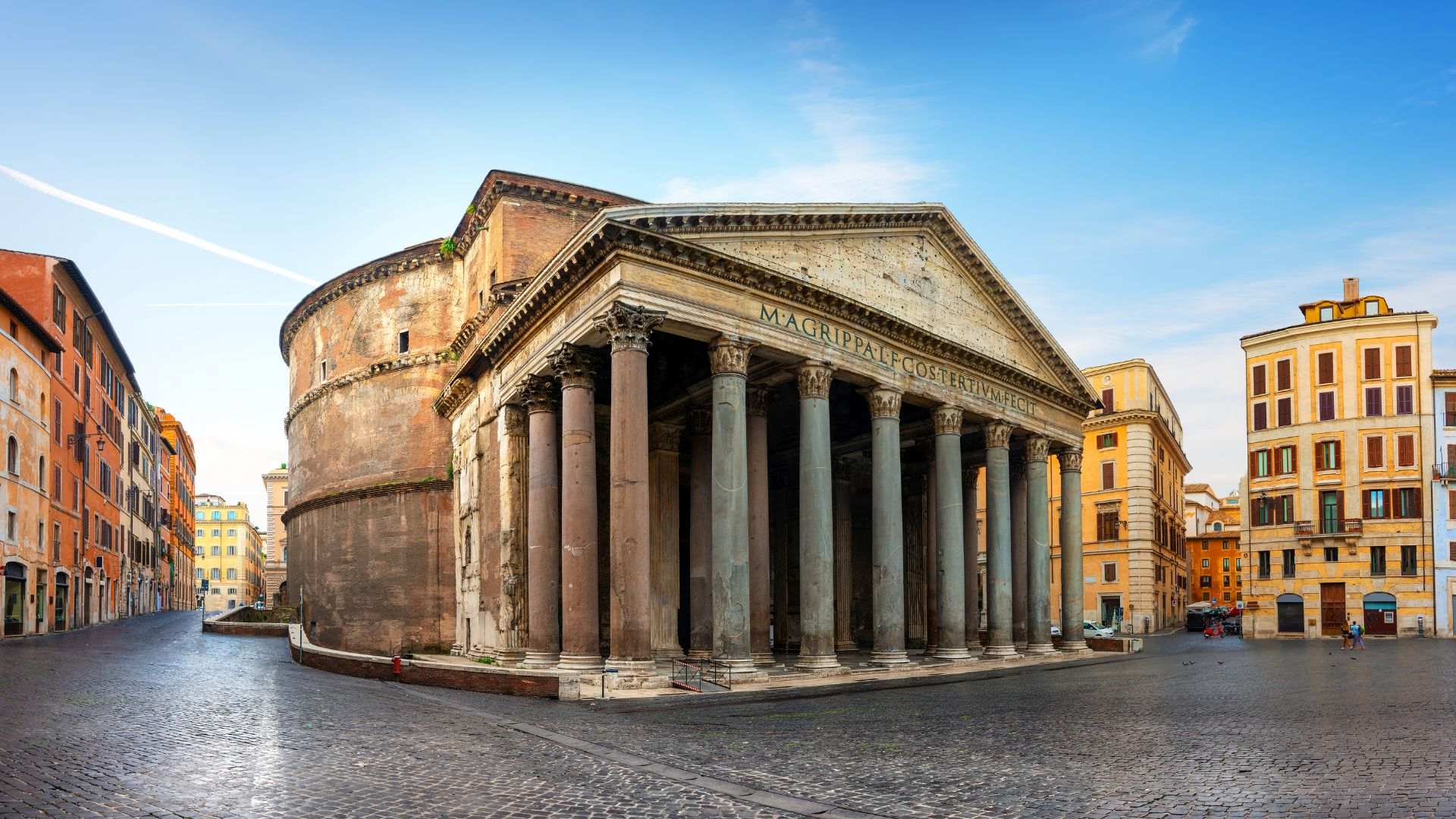
Its 16 granite columns stand almost 40 feet high and are a hint of the ingenuity that awaits inside. And as though to underscore its mystical character, the Pantheon’s only direct source of natural light is a circular hole — the oculus — at the very top of the dome, through which the light of the heavens streams in.
Many visitors confuse these two famous ancient buildings — you’re not alone.
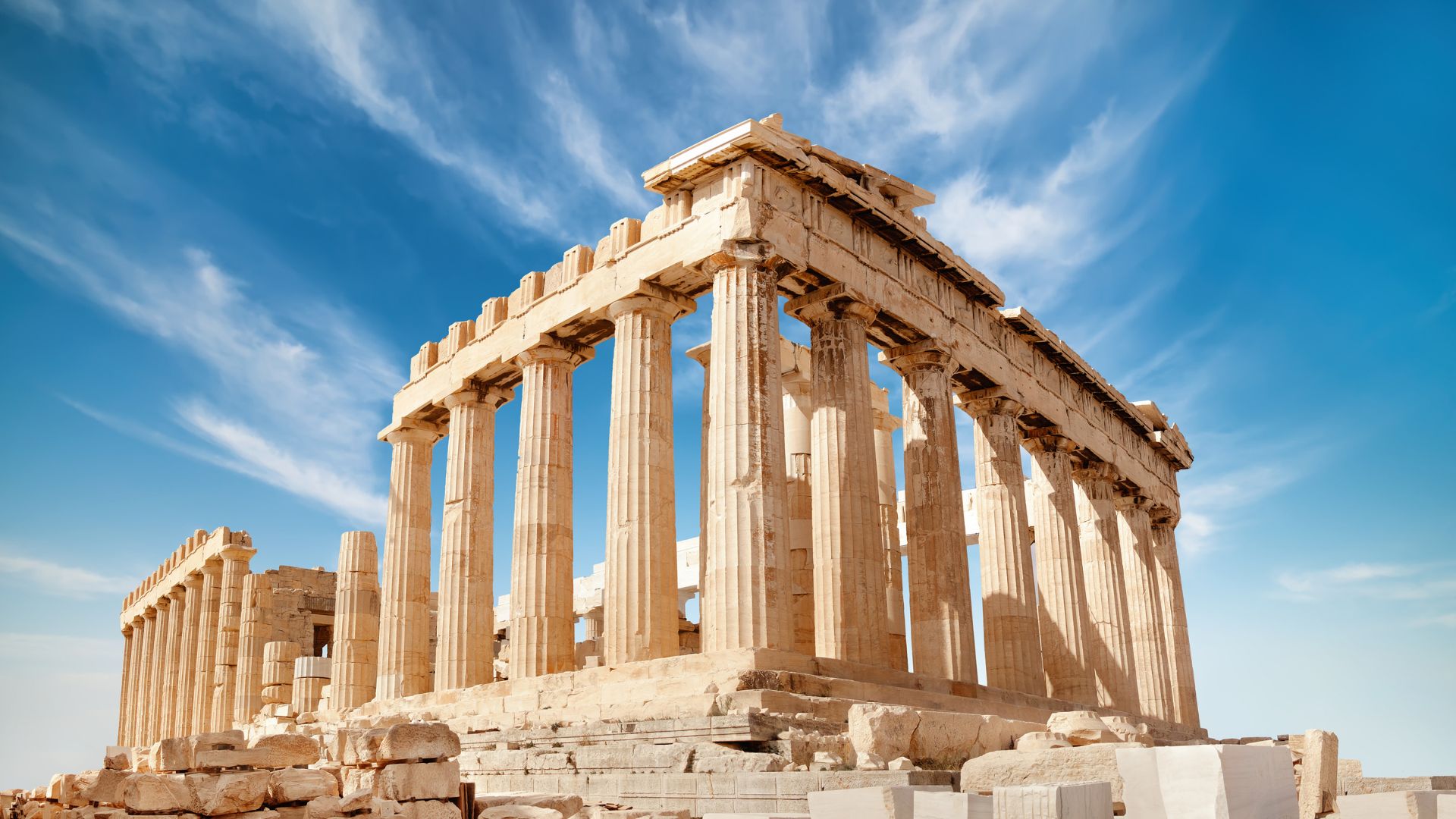
The portico is the magnificent colonnaded entrance — the one that looks like the front of the White House. This style of entry originated in ancient Greece and was a typical entrance for a Greek temple.
The 16 columns that make up the portico are made of solid granite and stand almost 40 feet high. Remarkably, they were quarried in Aswan, Egypt — some 3,000 miles from Rome — a feat of ancient logistics that is staggering to consider.
The floor of the portico is made of varying shades of marble, leading up to the Pantheon’s enormous bronze doors, which are among the largest surviving ancient bronze doors in the world.
The entrance, while opulent and spectacular, barely prepares you for the vast, serene beauty of the interior.
The space feels simultaneously like an airy church and something far more ancient and austere. The floor is original marble from nearly 2,000 years ago. The walls on either side are adorned with Renaissance works of art — paintings, statues, and frescoes — set into elegant niches.
The Pantheon also serves as a burial site. Entombed here are:
🔶 Raphael — the legendary Renaissance painter
🔶 Vittorio Emanuele II — the first King of unified Italy
🔶 Umberto I — the second King of Italy
Photography is permitted inside the Pantheon, and it is absolutely worth bringing a good camera. The best shot is looking directly up at the Oculus from the centre of the floor. Early morning visits offer the most dramatic light as the sun’s beam cuts through the interior.
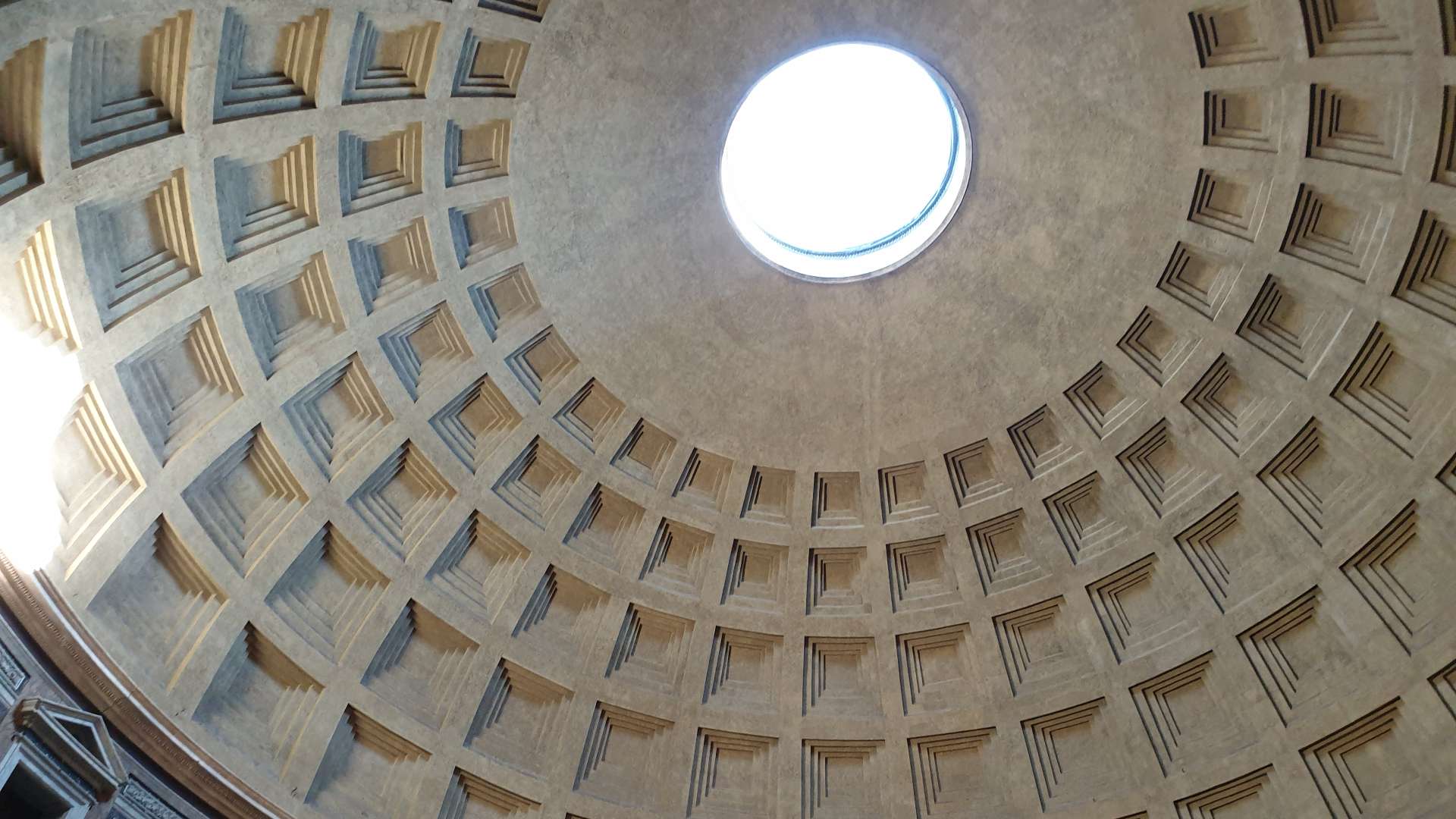
The dome is the undisputed centrepiece of the Pantheon — awe-inspiring before you even begin to consider the engineering brilliance behind it. Made of unreinforced concrete, it remains the world’s largest unreinforced concrete dome, a record it has held for nearly two millennia.
The interior of the dome is divided into 140 coffers — square, sunken panels arranged in five rings that decrease in size as they rise toward the apex. Originally decorated with gilded bronze rosettes, they serve both an aesthetic and a structural purpose: the pattern reduces the weight of the dome without compromising its strength. When you stand in the centre of the Pantheon and look up, the coffers create a hypnotic sense of perspective that draws the eye inevitably upward — toward the oculus.
At the very top of the dome sits the oculus — a circular opening 8.7 metres (approximately 29 feet) in diameter — the dome’s only source of natural light. There is no glass. It is simply open to the sky.
On a clear day, a perfect disc of sunlight enters through the oculus and moves slowly across the interior walls and floor as the earth rotates — a breathtaking effect that no photograph fully captures. You have to see it in person.
The oculus also lets in rain. This was entirely intentional — the original Roman drainage system built into the slightly convex marble floor channels rainwater away through hidden drains that are still in use today, nearly 2,000 years after they were installed.
The oculus is more than a light source — it appears to function as a precise solar instrument. At noon on the spring and autumn equinoxes, the beam of light passes through a grille set above the main entrance door, flooding the portico with light in a way that cannot be accidental. The building’s design almost certainly incorporated careful calculation of the sun’s movements.
Unlike every other sundial in the ancient world, which marks time by casting a shadow, the Pantheon’s marks time with the beam of light itself — a detail that feels both scientifically sophisticated and deeply poetic.
The number 28 — both the diameter of the oculus in Roman feet and the number of coffers in each ring — was considered one of only four “perfect numbers” known to antiquity. In a culture where numerology, astronomy, and religion were inseparable, these choices were anything but coincidental.
The engineering behind the dome is extraordinary even by modern standards. The concrete was not poured uniformly — it was laid in six distinct layers, with progressively lighter materials used as the dome rises. The lower layers use heavy travertine and tufa aggregate; the upper layers switch to lighter volcanic pumice, reducing the load at the point where structural stress is greatest.
There is no internal support structure. No timber frame remains inside the walls. The dome stands entirely on the logic of its own geometry — a continuous compression ring that has held for 1,900 years without reinforcement, without steel, and without modern engineering tools.
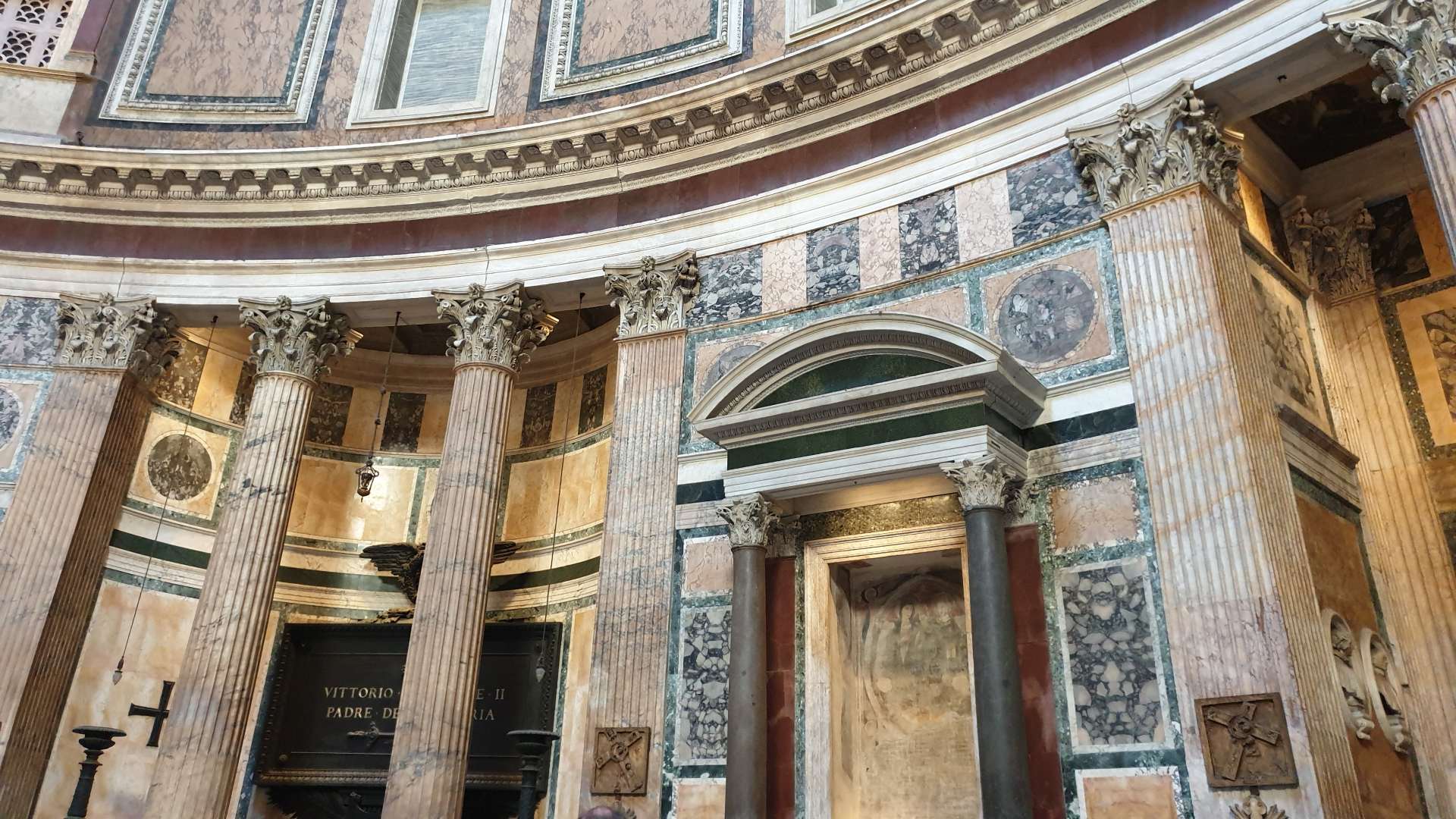
Beyond its architecture, the Pantheon is wrapped in centuries of historical mystery — including uncertainty about some of the most basic facts of its creation.
The Pantheon’s inscription reads: “Marcus Agrippa, son of Lucius, thrice Consul, built this.” For almost two millennia, this seemed to settle the matter.
But an 1892 study of the brickwork showed that the current Pantheon was actually built during the reign of Emperor Hadrian, more than 100 years after Agrippa’s time. The bricks were stamped with their date of manufacture — many dating to the 110s AD, placing them in the reign of Emperor Trajan, Hadrian’s predecessor.
The current scholarly consensus credits all three men:
🏛️ Agrippa — built the original structure around 25 BC, possibly with similar characteristics to today’s building
🏛️ Trajan — began significant rebuilding work after fires damaged the earlier structure
🏛️ Hadrian — completed and refined the building into the form we see today, likely with input on its design
So why did Hadrian keep Agrippa’s name on the inscription? One long-held theory is that it was an act of deliberate false humility — a way of currying favour with the capricious Roman gods. More recently, historians believe Agrippa’s original building genuinely deserved recognition as the architectural ancestor of the current structure.
Despite its name — pan (all) + theon (gods) — the exact purpose of the Pantheon has never been definitively established.
Roman historian Cassius Dio believed the vaulted roof gave the building its divine name, and that Agrippa actually intended it as a temple dedicated to the Emperor Augustus. Modern historians favour the theory that it was a temple dedicated to the entire dynastic line of emperors, beginning with Julius Caesar — a theory supported by the fact that the Pantheon is aligned on an axis with Augustus’ mausoleum.
By the 4th century, the niches inside the rotunda — originally occupied by statues of gods — had been replaced with statues of emperors. When Hadrian began holding court inside the Pantheon, the line between god and emperor was clearly being deliberately blurred.
Apollodorus of Damascus, Trajan’s master builder, has the strongest claim. He was responsible for Trajan’s Forum and several other major Roman projects, and there are tantalising structural similarities between his other known works and the Pantheon’s design. While ancient historian Dio claimed Apollodorus was later banished and executed by Hadrian — which long cast doubt on his involvement — this account has since been called into question, and circumstantial evidence continues to mount in Apollodorus’ favour.
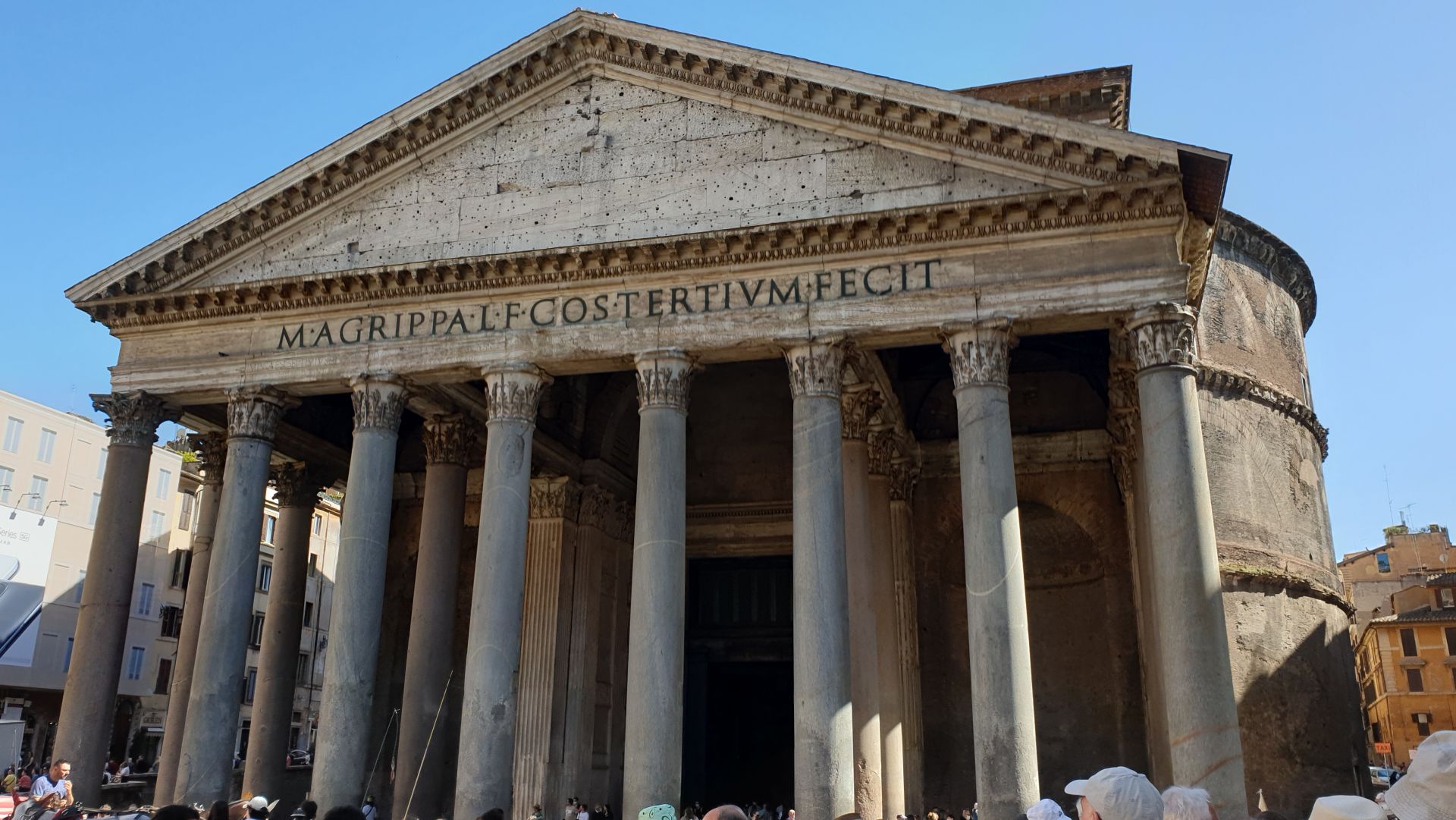
The Pantheon’s construction was a feat of advanced Roman engineering on a breathtaking scale.
🏛️ The walls are made of brick-faced concrete — the same material used in Rome’s legendary aqueducts — with relieving arches and internal vaults reducing their structural load.
🏛️ The dome (see above).
🏛️ The columns were imported from Aswan, Egypt; evidence suggests the portico was originally designed for taller columns, but substitutions had to be made when the originals were lost or damaged in transit.
The Pantheon was consecrated as a Christian church, probably in 613 AD, which made it a protected holy site and kept it in active use throughout the medieval period. Popes held regular masses here, ensuring it was maintained and guarded.
That said, the building has not been immune to the passage of time. Over the centuries, it was ransacked for valuable materials — much of its original bronze work, sculptures, and decorative elements are lost. Three columns on the east side spent centuries propped up by a brick wall before finally being replaced in the 17th century. The street level around the Pantheon has also risen significantly since Roman times, which is why the entrance now requires steps down into the portico rather than up.
Nonetheless, when you stand beside the Colosseum — which has lost two-thirds of its original stone — the Pantheon’s survival in near-complete form is nothing short of extraordinary.
Ready to Visit Rome?
At Take Me to Europe Tours, we create custom-planned trips to Rome and run small-group history tours throughout Italy. Whether you want a fully guided experience or a personalised self-guided itinerary, we’d love to help you plan it.
Dr. Monique Skidmore is a globally renowned anthropologist and the founder of Take Me To Europe Tours. She speaks four languages, has conducted immersive fieldwork across multiple countries, and divides her year between the Mediterranean, a cottage in northern England, and her home in the mountains near Melbourne, Australia. Through her small-group history tours across Italy and the Mediterranean, she brings the same depth of cultural curiosity to travel that she has applied throughout her academic career — helping travelers genuinely connect with the ancient world rather than simply pass through it.