Keywords
Minoan civilization, Knossos, Greek mythology, Minotaur, Theseus, ancient architecture, Crete, labyrinth, Zeus, Europa
Summary
This conversation delves into the rich history and mythology of the Minoan civilization, focusing on the Palace of Knossos in Crete. Monique Skidmore and Manolis Papadakis explore the ancient legends surrounding the Minoans, including the tales of Zeus, Europa, the Minotaur, and Theseus. They discuss the architectural significance of Knossos, the cultural impact of Minoan civilization, and its eventual decline due to various factors, including the arrival of the Mycenaeans.
Takeaways
- Crete is the largest of the Greek islands.
- The Palace of Knossos covers over three acres.
- The Labyrinth was designed by Daedalus to contain the Minotaur.
- Zeus transformed into a bull to seduce Europa.
- The Minotaur is a significant figure in Greek mythology.
- Theseus used a ball of string from Ariadne to navigate the labyrinth.
- The Minoan civilization was a major ancient power.
- The decline of the Minoans was multifaceted.
- The Minoans did not disappear but integrated with newcomers.
- The Palace of Knossos is a vital UNESCO World Heritage archaeological site.
Sound Bites
“Crete is the largest of the Greek islands.”
“Ariadne gave Theseus a ball of string.”
“It’s one of my favorite mythological stories.”
Timeline
00:00 – Introduction
01:59 – Labyrinths
03:13 – Origins of the Minoan Legend
06:05 – The Minotaur and the Labyrinth
08:51 – Heraklion Archaeological Museum
10:00 – Decline of the Minoan Civilization
11:35 – Conclusion
Transcript
Introduction (00:00)
Stephen Parker: Welcome to the Take Me to Europe podcast with your host, cultural anthropologist Monique Skidmore.
Monique Skidmore: If you thought the Parthenon was old, wait until you hear about the Minoan civilization of Crete. The magnificent palace of Knossos is over a thousand years older. We’re going to travel to Crete today and get up close and personal with a host of mythological figures: a bull and a minotaur.
Our guide to mythology and the ancient architecture of Crete and of the Palace of Knossos is the head of the Tour Guides Association of Crete, Manolis Papadakis.
Crete is the largest of the Greek islands, and it is an ancient centre of power that still influences the mainland. Crete didn’t become a part of Greece until 1913, but there was a settlement on the site of the current Palace of Knossos as far back as the 6th millennium BCE. But, as Manolis told me with a wry grin, if we were to dig down to excavate its secrets, we’d destroy the Palace above.
Crete was the centre of the great civilisation of the Minoans. The Minoan civilisation rose on this island 4,000 years ago and was abandoned by 1,100 CE, most likely when the Mycenaeans invaded Crete.
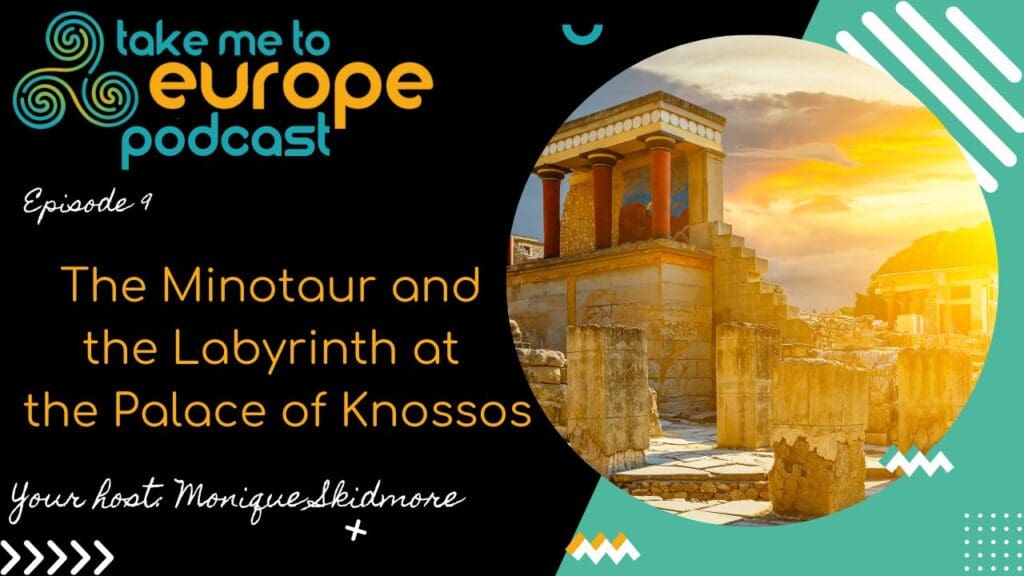
The ruins of the palace of Knossos can be found in Heraklion. It’s been called Europe’s oldest city. The palace building alone covers over three acres. This was the cultural and political heart of the Minoan civilization, and at its height, it had 18,000 residents, but by 1700 BCE, the population around the palace grew to 100,000. The palace had a ritual cult centre on the ground floor, and below the palace seems to be the most likely location of Daedalus’s labyrinth that imprisoned the Minotaur.
Labyrinths (01:59)
Monique Skidmore: And now a quick word on a favourite subject of mine the labyrinth. The labyrinth of Crete was a difficult and confusing path underground that Daedalus built at Knossos to contain the monster, the Minotaur. This mythological story has found its way onto Cretan coins where, from 400 BCE, a particular kind of labyrinth, it’s called a single-path, seven-course classical labyrinth, and that’s what’s depicted on these coins.
There are two general kinds of labyrinths the single-path labyrinth, where there’s just one way to eventually get to the centre, and the branching labyrinth. The single labyrinth is the design of most mazes above the ground, but it’s also used as a meditation when it’s drawn on the ground.
So, Daedalus and his labyrinth, the Minotaur, Theseus, King Minos, Ariadne – the world of Cretan mythology is rich and dense.
Let’s go and find our local guide, Manolis Papadakis. Manolis, welcome!
Manolis Papdakis: Hello Monique, nice being with you.
Monique Skidmore: Manolis, you’re a native of Crete. What draws you to its ancient sites?
Origins of the Minoan Legend (03:13)
Manolis Papdakis: Essentially, we have to take things from the beginning. And well, this is actually perhaps the most well-known ancient Greek legend and, as it usually goes, it starts with Zeus.
Jupiter, the most well-known ancient Greek god, the father of god and mortals, who at some time fell in love with Europa, the beautiful princess of Phoenicia. Phoenicia actually was not very far from Crete. Crete is very close to not only Egypt, but also the eastern basin of the Mediterranean Sea.
In so many words, what Zeus did was, in an attempt to seduce Europa, to transform himself into a beautiful white bull. He was successful in abducting Europa. He actually brought her all the way to Crete, and it was here that they kind of spent a certain night together, to put it this way, at the shade of an evergreen plane tree that one can still find in the fertile plain of Messara in the island of Crete.
So, shortly after that, Jupiter kind of abandoned Europa, who remained here in Crete, and she became the wife of the first king of the island, his name being Asterios.
Now, she eventually gave birth to the three legendary kings of Crete, so Minos, who gave his name to the Minoan civilization, Rhadamanthys in Greek, and Sarpedon. Radamanthes reigned over the palace of Festus, whereas Sarpedon was in the third Minoan palace, situated not that far away from Parnassus.
Now, sometime, Minos, in an attempt to prove to everyone that it was actually he who became the, let’s say, ruler of the whole of Crete, he turned to the gods and he asked for a sign, and Poseidon or Neptune, it’s always the same divinity decided to help him by sending him a beautiful white bull as a sign that, well, this is actually the guy we want.
So, Minos, unfortunately for him, what he did was to not sacrifice the animal. It was an offering of the gods, so he had to, let’s say, somewhere, return to them. He kept the bull in his flocks, which did not exactly please the Greek goddesses, who decided to punish King Minos, and so what Poseidon did was to turn to Aphrodite, or Venus, the Greek goddess of beauty, who well kind of made sure that Pasiphae, the wife, the queen of Crete, king Minos’ wife, fell in love with a bull, with a white bull.
That’s Greek mythology for you. So that’s where Daedalus comes. In Daedalus, what he does is actually to create a statue made out of wood and bronze. The queen kind of hid into the statue and eventually gave birth to the well-known Minotaur, the most well-known monster of Greek mythology, this huge man, this giant with the body of a man, obviously at the head of a bull, and who was promptly imprisoned into the library.
The Minotaur and the Labyrinth (06:05)
Monique Skidmore: Okay, that gets us through a lot of ancient mythology very quickly, thank you. So right now we’ve got a palace, we’ve got a labyrinth created by Daedalus around it, we’ve got a minotaur trapped within it, and we’ve got King Minos is that right? Presiding over the top of it.
Now, what happens to the Minotaur and how does the rest of that story keep moving on?
Manolis Papdakis: At approximately the same time, obviously, the Minotaur is imprisoned in the Labyrinth, which is actually the Palace of Knossos. So approximately at the same time, the Athenians, they kind-of assassinated King Minos’ oldest son, Androgyos.
And so King Minos, as you can very well understand, he organized an expedition against Athens, which he invaded and occupied, and it was actually there that he forced the Athenians to send him these rather famous 14 young men.
It’s a very famous part of the legend, these 14 young men and women who would from time-to-time come to Crete, end up in the Labyrinth and obviously eventually be devoured by the Minotaur.
So the Athenians kept on sending these young men and women to their death until the appearance of Theseus. Now, Theseus, who is definitely one of the most well-known ancient Greek heroes, along with Hercules, an Athenian hero who came to Crete in an attempt to put an end to all of this.
Well, here he kind of met Ariadne, who was the youngest and the most beautiful of King Minos’ daughters. So what she did was obviously she actually fell in love with him and decided to help him.
So she also turned to Daedalus, the same way her mother, pacify, had done before her. Because obviously, Daedalus decided to construct the statue after Pasiphae, the queen of Crete asked him to so this time, after the demand of Ariadne, Daedalus did give her, amongst other things, the so-called Ariadne’s clue, a ball of string that our hero Thessius used to enter the Labyrinth and leave it without any serious problems.
So what he actually did was to take this ball of string. He quite simply tied one end of the string at the entrance. He made his way to the Labyrinth, slowly unrolling the ball of string. Eventually, he came across the Minotaur, but he obviously killed it.
He afterwards made his way by following the string. He saved the other Athenians. He sabotaged the ships of the locals. He abducted Ariadne and Phaedra, her oldest daughter, and he began his trip back to Athens.
Archaeological Museum of Heraklion (08:51)
Monique Skidmore: It’s, I think, one of my favourite mythological stories and, as you mentioned, it is one of the most well-known. It’s got everything that a true epic needs to have, doesn’t it? Heroes, heroines, monsters, so much at stake, and then the help of the gods and that trickster, Daedalus, who is such a great character in Greek mythology, and so that brings an awful lot of weight then onto the history of the Palace of Knossos, this vast complex in Heracleion.
So, coming out of that mythology, there’s a whole bunch of symbols, of course, Mother Earth or nature, snakes, axes, labyrinth, the bull. So when you take people to the Palace of Knossos, and for our travelers, what should they want to see?
Manolis Papdakis: If someone has the possibility, the opportunity to visit the Palace of Knossos. If they can, they should definitely visit the Archaeological Museum of Heraklion because this will give them a better understanding.
In Knossos, they see the complex as it was obviously, and in the Museum of Heraklion, they can quite simply see an impressive number of objects found in situ in the site of Knossos.
Decline of the Minoan Civilization (10:00)
Monique Skidmore: Eventually, of course, even the mighty great European Minoan civilization fell. When and how did this civilization decline?
Manolis Papdakis: Now, the conventional end of the Minoan civilization is more or less at the end of the second millennium BC, so let’s say 1100 BC, which is approximately. Let’s round things up to some 3000 years ago.
The Palace of Knossos appears to have been destroyed at approximately, or abandoned, even better, a couple of centuries before that. Well, obviously the Minoans did not exactly disappear. They did not one day quite simply disappear into thin air.
But there was only one reason for the decline and fall of the Minoan civilization. So many associate the decline and fall, for example, to the arrival of the Mycenaeans, another well-known Greek tribe that came from continental Greece.
Mycenaeans, the house of Atreides, obviously where the tomb of Agamemnon can be found today. So the arrival of newcomers, natural disasters and so on. They slowly pushed the Minoans to the eastern part of the island, which is the most barren and arid part of the region, and they were slowly, let’s say, replaced, their palaces occupied, their cities rebuilt, and so on, but nonetheless, they did not exactly disappear.
They kept on living,g and they eventually became one with the newcomers, or perhaps it would be best to say that the newcomers eventually became one with the already existing Minoans.
Conclusion (11:35)
Monique Skidmore: That has been fascinating, manolis, and today we’ve learned about one of those great historical civilizations in the ancient world at its monumental palace complex at Knossos.
We’re thrilled learn of the exciting mythology of ancient Greece and we’ve learned about the symbols, architecture and the eventual demise of the great Minoan civilization.
Well, I’d really like to thank Manolis Papadakis for being our guide to this fascinating civilization and to the great ruins of Knossos.
Manolis Papdakis: Thank you, Monique, for having me.
Stephen Parker: Thanks for listening to this episode of the Take Me to Europe podcast. Hop onto our website, takemetoeuropetours.com and sign up to our newsletter to learn more about Europe’s hidden and most exciting destinations, and don’t forget to subscribe to the podcast series.