The 8 best beaches in Tinos are some of the most relaxing beaches in the Greek Cyclades islands, but don’t tell anyone! The beaches are diverse and range from pebbly to sandy beaches, and from fully organized beaches to secluded ones where the only amenity is natural shade. Here’s a comprehensive guide for everything you need to know about the 8 best beaches in Tinos for your next vacation.
Tinos Island is a Greek island in the Aegean Sea, and one of the Cyclades group of islands. It is less than 4 hours to Santorini, only 80 minutes to Paros and Naxos, and only 35 minutes by ferry from Mykonos.
For centuries, it has been a famous destination for Christians in Greece and abroad, as there are more than 1000 churches on this island.
Among them is the Holy Church of the Virgin Mary Evangelistria at Tinos, the most well-known church in Greece.
However, in recent years, Tinos Island has become one of the most popular Greek islands for eco-holidays as well, as more people discover the beauty of the villages and the beaches of the island.
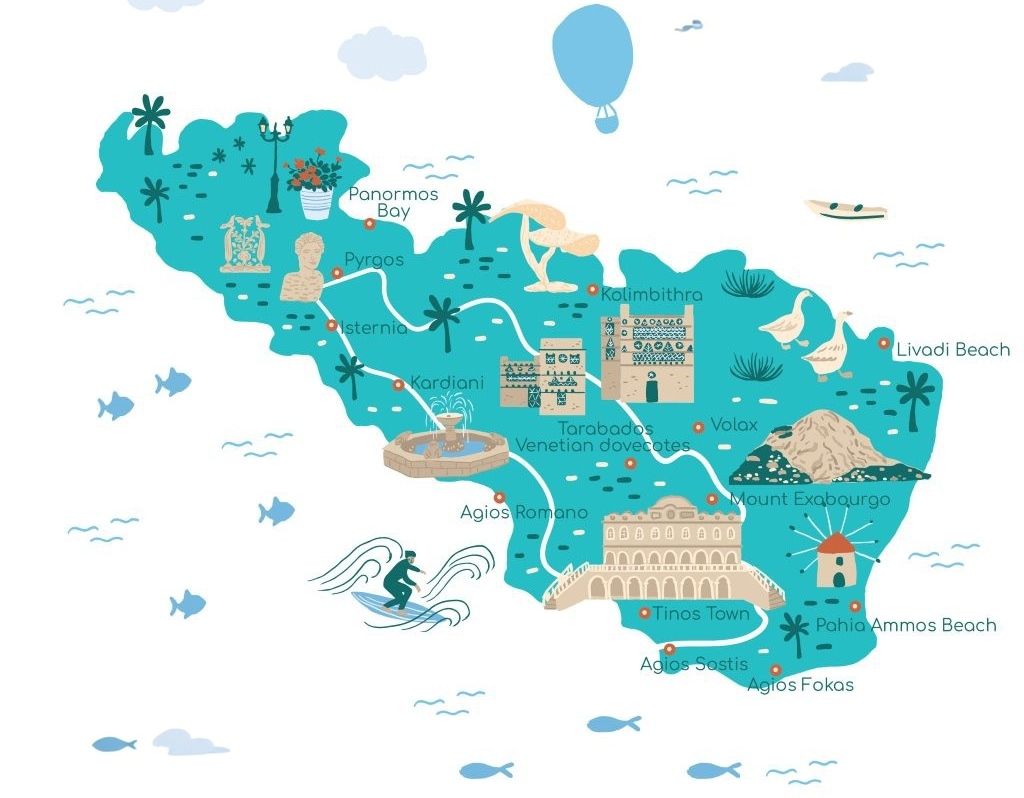
Tinos is swimmable for much of the year, but the feel of the beaches changes a lot between spring, the peak of the meltemi, and the quieter shoulder months.
🌊 April–May: Mild days, cooler water (around 16–19°C), and very quiet beaches – this is a lovely time if you enjoy walking, wildflowers, and the villages and don’t need to swim for hours every day.
🌊 June: The sea usually passes 22°C and starts to feel properly warm, most beach bars are open, and the meltemi has usually arrived but is often moderate rather than fierce.
🌊 July–August: High summer brings the hottest air temperatures, the liveliest atmosphere, and the strongest meltemi winds; it’s perfect if you like energy, long beach days, and water sports, but some exposed north‑coast beaches can be very windy and wavy.
🌊 September: The sea is often at its warmest (around 24°C), the evenings are slightly cooler, crowds thin out, and the winds are usually more manageable – for many travelers, this is the sweet spot for a beach holiday on Tinos.
🌊 October: The water often stays around 21–22°C, so you can still swim comfortably on sunny days, but services start to wind down, and the island becomes noticeably quieter.
On days when the meltemi north wind is strong, it’s much more pleasant to choose sheltered bays like Agios Ioannis Porto, Agios Sostis, or Agios Romanos and avoid fully exposed north‑coast beaches such as Kolimpithra and Rochari.

| Month | Avg sea temperature | How it feels for swimming |
|---|---|---|
| January | ~16°C | Cold – quick dips only for most people. |
| February | ~15–16°C | Cold. |
| March | ~16°C | Cold; usually only for hardy swimmers. |
| April | ~16–17°C | Bracing but swimmable on sunny, calm days. |
| May | ~18–19°C | Cool but comfortable for many, especially midday. |
| June | ~22°C | Pleasantly warm; start of easy, everyday swimming. |
| July | ~24°C | Warm; ideal for long swims. |
| August | ~25°C | Warmest of the year; “bath‑like” for many travellers. |
| September | ~24°C | Still very warm and comfortable. |
| October | ~22°C | Pleasant, especially early in the month and on calm days. |
| November | ~19°C | Cooling; good for confident or regular sea swimmers. |
| December | ~17°C | Cold again; mainly for short dips. |
| Beach | What it’s like | Wind & conditions | Facilities & atmosphere |
|---|---|---|---|
| Kolimpithra | Two sandy beaches in one bay – a surf‑facing “big” beach and a more sheltered small cove. | Very exposed to the north wind; great on calm or breezy days and for surfers when the meltemi is strong, but can feel wild and wavy for relaxed swimming. | Small beach bar/taverna, sunbeds and a boho, surfy vibe; can feel busy around the bar in high summer. |
| Livada | Wild, pebbly bay framed by striking, sculpted rocks and almost no development. | Exposed and best on calmer days or when winds are light to moderate; waves and currents can feel stronger here. | No organized facilities; you need to bring shade, water, snacks and good footwear. |
| Agios Ioannis Porto | Classic holiday bay with soft sand, shallow water and accommodation right behind the beach. | More sheltered than the north coast, though still affected by strong winds; a good choice when Kolimpithra or Rochari are too rough. | Organized sections with sunbeds, beach bars and tavernas; can feel lively and busy in July–August. |
| Agios Sostis | Quieter continuation of the same bay, with more trees and long stretches of sand. | Fairly sheltered, but choppy in very strong winds; generally gentle enough for relaxed swimming. | A mix of unorganized shore with natural shade and a small organized area with a beach bar; more low‑key than Agios Ioannis Porto. |
| Agios Fokas | Long “town beach” starting just outside Chora, with sand and easy access. | Conditions vary along the beach; best earlier or later in the day in peak summer, and on days when winds are not at their strongest. | Several beach bars and tavernas along the coastal road; popular with locals for after‑work swims and sunset. |
| Agios Petros | Secluded sandy cove under Kardiani, split by a rocky outcrop crowned with a tiny church. | Relatively sheltered compared with fully open north‑coast beaches; still check conditions, especially with small children. | No facilities and access via a narrow road and steps; feels quiet and “away from it all”, best for independent travellers. |
| Agios Romanos | Long, gently curving bay with soft sand and tamarisk trees for shade. | One of the most reliable options on very windy days; usually more protected from the meltemi than the north‑coast beaches. | Small beach bar and scattered rooms, with much of the beach left unorganized and peaceful even in high season. |
| Rochari | Wide sandy beach near Panormos with low dunes and a broad horizon. | Very exposed to the meltemi; excellent if you enjoy waves, wind, and water sports, but not ideal for toddlers on rough days. | Stylish but relaxed beach bar with sunbeds and pergolas; draws a boho crowd and pairs well with a visit to nearby Panormos and Pyrgos. |

You can get to Tinos by ferry from Athens. You can either start your journey in Piraeus, the largest port in Greece, or Rafina, the smaller port in Athens further away from the city.
The trip takes around four hours, depending on the type of ferry you choose.
Boarding a Fast Ferries ferry at Tinos Port to Rafina, Greece
Tinos town contains the port, and from there you can walk to the bus station to get around the island. Tinos town is the busiest place on the island with many shops, restaurants, and bars.
If you’d like to discover the villages of Tinos island, choose one to be your base and explore the rest of the island from there by renting a car.
Public transport does not cover the whole island with regular routes and frequent timings. Driving is straightforward, though many roads are narrow and winding; traffic is generally light outside the main town.
Having your own vehicle will allow you to visit all the best beaches in Tinos, as well as the villages dotted around the island in the most convenient way.

Kolimpithra is a bay in the north of Tinos, and it is actually two beaches: Big Kolympithra and Small Kolimpithra (Mikri Ammos and Megali Ammos). Both of them are sandy and have crystal-clear waters.
At Kolimpithra, I love that you really do get “two beaches in one.” The big, surf‑facing side has a wonderfully boho beach bar, loud music, and proper waves when the meltemi blows, so it feels more like a surf spot than a classic swim beach on windy days.
The small cove, by contrast, is much more sheltered; when the wind isn’t howling, it’s the place I’d choose for an easy swim, and on wild days it’s where people retreat to lie in the sun while watching the surfers tackle the swell and whatever seaweed or plastic the wind has pushed into the bay.
The small beach offers sun loungers and umbrellas and there is a restaurant that serves local delicacies. Expect around €15–25 for two sunbeds and an umbrella on the organized part in high season, more for ‘premium’ rows or canopies. On the organized small beach there are basic facilities (toilets, showers, changing cabins) provided by the beach bar/taverna.
The larger beach has a canteen that offers snacks and drinks and small umbrellas that look like mushrooms! Apart from the umbrellas, the beach is not organized and is usually not very crowded.
Many of the beaches in Tinos are in the north, and when there is a north wind blowing, there can be large waves, and the wind can make lying on the beach unpleasant.
Of course, this means the beach is ideal for surf lovers, as you can rent your gear there and try to catch a wave. In season, you can usually rent surfboards; expect prices in line with other Greek islands, and check the current board outside the kiosk for exact rates. Surfing lessons are also offered.
There is a car park near the beach and additional roadside parking, but in August, it can be very crowded, and the narrow access road can back up, so go early.
Strong currents can develop between the two beaches during north (meltemi) winds. The rocky outcrop separating the beaches can be slippery – wear water shoes. The small, organized beach is usually supervised by a lifeguard in the main summer season, but coverage can change from year to year, so do not rely on it and always check local signs.
Tip: The beaches on the north of Tinos are best on calm days unless you want to surf.
Taste local food with great views, right on the beach, at Drakonisi.

Livada Beach is the pebbly part of Livada Bay. It has a wild beauty and is one of the most impressive in Tinos.
There are twisted rocks on the shore that have been created over time by the wind and saltwater.
Livada always feels like a little expedition to me. The final stretch of road is slow and bumpy, so it keeps the crowds away, and when you arrive, you step out into a raw landscape of sculpted rocks and pebbles that looks almost lunar against the bright water. There are no services at all and very little natural shade, so I treat it as a true “bring everything with you” beach – umbrella, plenty of water, proper footwear – and enjoy the quiet and the sense that you’re far from the more polished Cycladic scene.
This beach has no facilities, so make sure to pack your own supplies, including:
Sun umbrella (no natural shade until late afternoon)
Plenty of water (nearest shop is 6km away)
Beach shoes (essential for the pebbly shore)
First aid basics
Livada is reached by a narrow road with a rough unpaved section near the end; drive slowly, especially with a low‑clearance car. There is only informal parking near the beach, rather than a marked car park
You will share the beach with its residents, goats that find shade in the caves that the rocks form. Watch out if they approach – they want to steal your food!
Livadi Beach does not have guaranteed lifeguard services; always check local conditions and swim within your ability. The bay is generally calm but can have strong currents near the rock formations. Mobile phone signal is weak – download offline maps before visiting.
At only six kilometers from Livada, you will find the beautiful village of Falatados. You can have a nice lunch or dinner at Bread and Salt.

In the southern part of Tinos, you’ll find Agios Ioannis Porto beach. It is a protected bay behind Agia Kyriaki peninsula.
Agios Ioannis Porto is where Tinos feels most like a classic, easygoing Greek beach resort. The sand is soft and the water usually shallow and clear, and there’s a continuous line of small hotels, rooms, and tavernas just behind the beach, so you can quite literally roll out of bed and onto the sand. In high summer, it does get busy, especially around the organized section and the better‑known beach bars, and if you’re driving in the middle of the day, you need to be patient with parking – but for a “no‑effort” swim with food and drinks on hand, it works very well.
This beach is one of the most cosmopolitan, and you can find restaurants, beach bars, and various stores there. There are parts of the beach with sun loungers and umbrellas. These are in the €15–25 range, sometimes with minimum consumption instead of a fixed rental. Agios Ioannis Porto has basic facilities, including toilets near the organized sections and cafés, but services are limited compared to larger resort beaches.
The beach is covered by sand with small stones. The waters are crystal clear and shallow, and that’s why this beach is ideal for families with children. The shallow waters extend 20-30 meters from shore, making it perfect for young swimmers. Water shoes are recommended due to small stones.
The bay is surrounded by rocky hills, and there are many luxury hotels in the area. Also, the famous beach bar La La Louza is situated here (see pic above), where you can enjoy a drink or snack.
Agios Ioannis Porto can be reached by car or summer bus from Tinos Town, and there is parking close to the beach, though it can be busy in peak season.
There are no dedicated lifeguards. First aid station at La La Louza beach bar. The bay’s protection means calm conditions even on windy days. Beach wheelchair available on request.
Traditional Greek dishes with meat and seafood are offered at Akti Aegeou Restaurant.

A short walk from Agios Ioannis Porto with take you to the beach of Agios Sostis. Agios Sostis feels like the more relaxed, leafy continuation of the Agios Ioannis bay. As you move along the shore, the crowd thins out, the trees start to offer proper natural shade, and the whole atmosphere becomes less beach‑club and more simple, family seaside.
It’s one of those places where, if you’re willing to walk just a little further away from the main access point, you can still find plenty of space even in August, with soft sand underfoot and generally gentle water for long, lazy swims.
This beach offers fine sand, and many trees that create natural shade, and you can find a beach bar with sun loungers and umbrellas, and a couple of restaurants within walking distance. Where there are organized sections, prices are generally lower than at the most fashionable beaches of the Cyclades; budget roughly €10–20 for a set, or a minimum spend at the bar. Free public showers and basic changing facilitiesare available.
The water is usually clear and shallow, and is popular with families, but it can still be choppy in strong winds. Thus, the beach is family-friendly even with smaller children. At one end of the beach, there is the church of Agios Sostis, which has stood since the 19th century.
There is roadside parking and some space near the beach; in summer, it can fill up, especially near the organized section. Agios Sostis is the next stretch of beach around the bay from Agios Ioannis Porto. You can walk between them along the sand and local road in a short time, but the surfaces are mixed (sand, some uneven sections), so it is only partly suitable for strollers and wheelchairs.
Agios Sostis beach does not have guaranteed lifeguard services; always check local conditions and swim within your ability. Rocky areas at both ends of the beach – supervise children. Jellyfish occasionally present in late summer (August-September).
Enjoy food and drinks, including their signature cocktails, at Kapari.

Agios Fokas beach is a long sandy beach close to Tinos town. Agios Fokas is the beach I think of as “Chora’s front yard.” The sand starts just beyond town and runs for a long way, so you can choose between the sections with cafés and sunbeds and quieter stretches where it’s mainly locals coming down for a quick afternoon dip.
I like that you can walk or cycle here along the coastal road, swim, then slip straight into a taverna or bar above the beach; around sunset, it fills up with islanders finishing work, which gives it a very lived‑in, everyday Greek feel.
It is a lovely beach with only one part of it being organized, while the other part remains unspoiled, with only a few trees offering shade to its visitors. Like at Agios Sostis, where there are organized sections, budget roughly €10–20 for a set of sun loungers, or a minimum spend at the bar.
Along Agios Fokas you can use the toilets in the beach bars and cafés that line the coastal road; there are no large stand‑alone public restroom blocks.
There are beach bars where you can have food and drinks, and rent sun loungers and umbrellas. The generally gentle waters and soft sand make it popular with families The beach has a gradual depth increase, ideal for children. Blue Flag certified for water quality.
Also, on the road directly on top of the beach, you can enjoy a scenic route for a run or a walk. The 2km coastal path is popular with joggers and connects to Tinos town.
Parking
You can walk from Tinos Town or drive; there are parking areas at the ends of the beach and along the coastal road. Agios Fokas is a long sandy beach just outside Tinos Town, starting about 1 km from the centre. Many visitors simply walk or cycle there along the coastal road, or take a short bus or taxi ride.
Safety
Agios Fokas is a long, organized beach close to town, and there is a lifeguard tower in season, but coverage and hours can vary, so do not rely on constant supervision. Generally very safe with calm conditions. The beach bar provides first aid.
Try some fine Mediterranean cuisine at Olive in Vrekastro

Agios Petros is a secluded beach in the southern part of the island. Agios Petros is one of those beaches that really rewards a little effort. The drive down is on a small road, and the final approach is a steep set of steps, but when you reach the bottom, you find a quiet cove of sand and clear water beneath the village of Kardiani, split in two by the rock crowned with the tiny church of Agios Petros. There are no facilities and no noise beyond the sea and a few fellow swimmers, so it’s a place where I love to spend a couple of hours just floating and looking back up at the terraces of the village on the hill.
Agios Petros is close to the beautiful small village of Kardiani, and it can be reached via a 2-kilometer dirt road.
There is a large rock that separates the beach into two, and on the top of it stands the church of Agios Petros since the 16th century. This is a sandy beach with calm and clear waters.
There are no facilities on the beach or trees for natural shade. Essential items to bring: umbrella, water, snacks, first aid kit, and sun protection. Nearest facilities in Kardiani village (15-minute drive).
Parking
There is informal parking very close to the beach at the end of the road, but space is limited, and the last part of the road, plus the steps down, make it unsuitable for those with mobility issues.
Safety
Agios Petros beach does not have guaranteed lifeguard services; always check local conditions and swim within your ability. No mobile signal in most areas. Not recommended for solo swimmers. The dirt road becomes impassable in heavy rain.
After your swim, head to On Tinos for amazing seafood dishes.

Agios Romanos is one of the most beautiful beaches in Tinos, situated in the southwest of the island. It’s become my favorite beach for unhurried full‑day swims. The sand is soft, the bay is usually sheltered, and the line of tamarisk trees along parts of the shore means you can move between sun and shade without ever leaving the beach.
Even in August, it rarely feels packed: wander a short distance from the small beach bar, and you’ll often find long stretches with only a scattering of people, and the late‑afternoon light over the bay and the little islets offshore makes it very tempting to stay right through sunset.
The bay is usually sheltered from the north wind, so the sea is often calmer here than on more exposed beaches. The bay’s orientation protects the meltemi (north wind), making it a reliable swimming spot when northern beaches are rough.
Agios Romanos is also a family-friendly beach, as the sand is soft and the sea is always calm. Water depth increases gradually – perfect for children. The seabed remains sandy throughout, with no hidden rocks or sudden drops.
At one end of the beach, you’ll find the beach bar with sun loungers and umbrellas. The rest of the beach is not organized, but there is natural shade.
The beach bar offers sunbeds, simple cabanas and pergolas; prices start around €10–15 for a basic set and rise for more spacious shaded options. The tamarisk trees provide excellent free shade. Restroom access is normally through the beach bar or nearby tavernas, so plan to buy a drink or snack if you need facilities.
Parking
Agios Romanos is about a 20‑minute drive from Tinos Town along a narrow but reasonable road, with ample parking close to the beach.
Safety
Agios Romanos beach does not have guaranteed lifeguard services; always check local conditions and swim within your ability. Very safe swimming conditions – shallow, calm water.
At a short drive from Agios Romanos, you will find the area of Kionia and taste fresh food at Tsampia.

Rochari Beach is one of the best beaches in Tinos, on the north coast and very close to the fishing village of Panormos. It always strikes me as the most “boho” of the Tinos beaches.
There’s a relaxed beach bar with wooden pergolas and cushions, a long sweep of sand backed by low dunes and trees, and on many days a proper north Aegean wind that whips up waves and draws in people who like a bit of drama in the water or come for SUP and other water sports.
When the meltemi is really howling, I tend to treat Rochari as a place for long walks, a drink, and people‑watching, and then pair it with a calmer swim over in Panormos or nearby coves where the sea is less exposed.
The beach is long and covered in fine sand. There is a very impressive beach bar that offers sun loungers and umbrellas as well as wooden kiosks with cushions. Sunbeds and simple pergolas are available from roughly €10–20 per set in high season, with larger daybeds costing more. At Rochari, the main beach bar provides toilets, showers, and simple changing cabins for its customers.
Great cocktails and snacks are served, and you’ll sometimes find live music in the evenings. DJ sets Friday-Saturday nights in July-August. The restaurant serves full meals until around 10 pm.
The beach also has trees, and it is easy to park your car as there is plenty of space. Also, you can rent gear and try several different water sports. In season, you can usually rent SUPs, surfboards, or kayaks; expect prices in line with other Greek islands, and check the current board outside the kiosk for exact rates. Lessons are also available.
Parking
Rochari is around a 40‑minute drive from Tinos Town, with plenty of space to park close to the beach, though it can be busier in high summer and on weekends.
Safety
Rochari is exposed to the north wind and can be very wavy, especially in summer; follow any local warnings and only swim if you are confident in rough water. There may be staff from the water‑sports operators on the beach, but you should not assume full lifeguard cover.
If you choose this beach for a swim, don’t miss the opportunity to visit the village of Pyrgos. Pyrgos is the biggest, and I think it’s the most beautiful village in Tinos, and it is only a few minutes away from Panormos.
In fact, a day spent in Pyrgos and beautiful Panormos Bay is a great one-day itinerary when you’re holidaying on Tinos.
Try local mezzes at Panormos at Sima.

🏖️ Kionia Beach (known for its many restaurants)
🏖️ Santa Margarita Beach
🏖️ Agia Thalassa Beach (cove)
🏖️ Giannaki Beach
🏖️ Vourni Beach
🏖️ Malli Beach
Explore more of Greece with our guided tours, or browse our complete Visit Greece section for island and mainland itineraries.

Monique Skidmore, PhD, is an award-winning travel writer and anthropologist with more than 25 years’ experience leading travelers through Greece and the Mediterranean. As founder of Take Me To Europe Tours, Monique creates expert-led journeys to Greece’s most historic and beautiful regions, sharing cultural insights and practical advice shaped by her academic background and extensive knowledge of the country.
Monique’s writing covers Greek islands large and small, including guides to archaeological treasures, coastal villages, and authentic food traditions. Her expertise is recognized in international media, where she emphasizes sustainable, respectful approaches to discovering local life in Greece.
For additional tips and destination guides across Greece, visit her About page or browse the Greece content library at Take Me To Europe Tours.